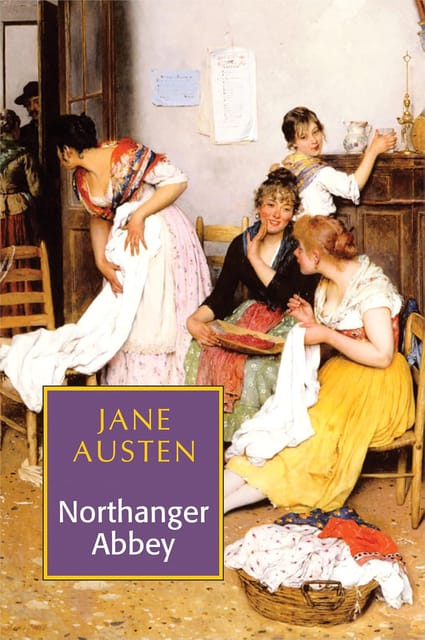
Northanger Abbey, written during the same period as Pride and Prejudice and Sense and Sensibility, represents Jane Austen's genius at its freshest and most enchanting. It grew out of her distaste for the absurdities of the novels of her time and in particular, for the conventions of the Gothic novels with their impossibly perfect heroines and unnatural events. Young Catherine Morland, the heroine of the novel, is the mistakenly invited guest at an isolated, and quite mysterious, country manor. There the charming, young husband-seeker falls in love with Henry Tilney, son of the eccentric General Tilney, and is fortunate to gain his father s approval, which is founded upon the exaggerated report of her parents wealth. Catherine is invited to Northanger Abbey, the medieval seat of the Tilneys. Somewhat unbalanced by a too assiduous reading of Mrs Radcliffe s novels, she imagines numerous gruesome secrets surrounding the General and his house. Before Catherine s difficulties are resolved, the reader witnesses the romantic chase in all its prescribed ritual, and its prime motivations-ambition, pleasure, greed, power, self-interest.... love. Jane Austen s wonderful comedy of errors has become one of the best loved of all novels.
About the Author
Jane Austen (1775-1817) was the daughter of a well-off, cultivated Hampshire clergyman, the Rev. George Austen. She was the sixth in a family of five sons and two daughters. Her main education was from her father. As a child and young woman she read widely, including among novelists, Fielding, Sterne, Richardson, and F. Burney; and among poets, Sir W. Scott, Cowper, and her particular favourite, Crabbe. She began her literary career by writing parodies and sketches for the amusement of her family. Some of these were later worked up into the major novels of her maturity. Her life is notable for its lack of events; although she had several suitors, she did not marry. In 1801 the family moved to Bath, in 1806, after Mr. Austen s death, to Southampton, and 1809 to Chawton, again in Hampshire, where she lived till her death in 1817.








 +91 9818282497
(2).png)