Shop No.20, Aurobindo Palace Market, Hauz Khas, Near Church +91 9818282497 | 011 26867121 110016 New Delhi IN
Midland The Book Shop ™
Shop No.20, Aurobindo Palace Market, Hauz Khas, Near Church +91 9818282497 | 011 26867121 New Delhi, IN
+919871604786 https://www.midlandbookshop.com/s/607fe93d7eafcac1f2c73ea4/69591829db7aed90e0608dfb/without-tag-line-480x480.png" [email protected]
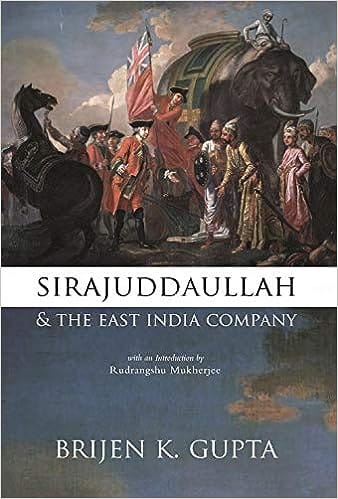
9788178246352 64e8a173f631990e97467f74 Sirajuddaullah And The East India Company https://www.midlandbookshop.com/s/607fe93d7eafcac1f2c73ea4/64e8a174f631990e97467fe4/41etea2dqgl-_sx336_bo1-204-203-200_.jpg
In the first half of the eighteenth century there was a prolonged battle of words between successive nawabs of Bengal and the East India Company. The dispute was over the private trade of the company's employees: the nawabs argued that while the company had been allowed to trade without paying into their coffers, the private trade of Company employees was not duty-free. As pointed out by Rudrangshu Mukherjee in his introduction to the reprint of this classic work, brijen Gupta was among the first to show what "was at the heart of the conflict between the company and sirajuddaulah... [The issue that] paved the way for the battle of Plassey as well as its momentous aftermath." brijen Gupta was also, says Professor Mukherjee, among the first to draw attention to "the meshing of the interests of the company and the British government in London. It continues to be argued by some British historians... That there was no official plan or project to acquire possessions in India, let alone build an empire. The empire came about Fortuitously, in a fit of absentmindedness, it was asserted. Contradictions and overturning this view, Gupta showed that 'in England, in the eighteenth century, the English company had become a national institution in its political and economic life. The foreign policy of England on Asian questions quite often reflected the interests of the East India Company.' The East India Company, gupta's book demonstrated, was not just a trading body but a political entity articulating British imperial ambitions." every student of Indian history will value this reprint of an old, out of print, and hitherto unavailable classic. Extensive documentation of the river Ganges from source to mouth.


About the Author

Brijen K. Gupta (1929-2018) earned his PhD from Yale. He taught in New Zealand and later at Rochester, New York.

9788178246352
out of stock INR 476
1 1
Sirajuddaullah And The East India Company

Sirajuddaullah And The East India Company

ISBN: 9788178246352
₹476
₹595   (20% OFF)


Back In Stock Shortly - Fill The Book Request Form

Details
  • ISBN: 9788178246352
  • Author: Brijen K Gupta
  • Publisher: Permanent Black
  • Pages: 184
  • Format: Paperback
SHARE PRODUCT

Book Description

In the first half of the eighteenth century there was a prolonged battle of words between successive nawabs of Bengal and the East India Company. The dispute was over the private trade of the company's employees: the nawabs argued that while the company had been allowed to trade without paying into their coffers, the private trade of Company employees was not duty-free. As pointed out by Rudrangshu Mukherjee in his introduction to the reprint of this classic work, brijen Gupta was among the first to show what "was at the heart of the conflict between the company and sirajuddaulah... [The issue that] paved the way for the battle of Plassey as well as its momentous aftermath." brijen Gupta was also, says Professor Mukherjee, among the first to draw attention to "the meshing of the interests of the company and the British government in London. It continues to be argued by some British historians... That there was no official plan or project to acquire possessions in India, let alone build an empire. The empire came about Fortuitously, in a fit of absentmindedness, it was asserted. Contradictions and overturning this view, Gupta showed that 'in England, in the eighteenth century, the English company had become a national institution in its political and economic life. The foreign policy of England on Asian questions quite often reflected the interests of the East India Company.' The East India Company, gupta's book demonstrated, was not just a trading body but a political entity articulating British imperial ambitions." every student of Indian history will value this reprint of an old, out of print, and hitherto unavailable classic. Extensive documentation of the river Ganges from source to mouth.


About the Author

Brijen K. Gupta (1929-2018) earned his PhD from Yale. He taught in New Zealand and later at Rochester, New York.

User reviews

  0/5