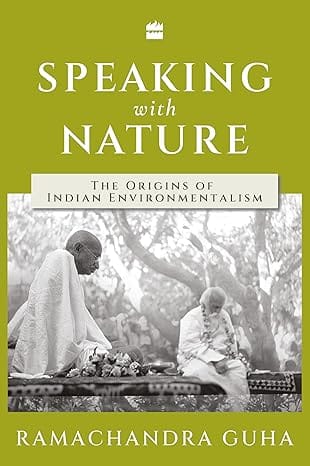
By the canons of orthodox social science, countries like India are not supposed to have an environmental consciousness. They are, as it were, 'too poor to be green'. In this deeply researched book, Ramachandra Guha challenges this narrative by revealing a virtually unknown prehistory of the global movement set far outside Europe or America. Long before the publication of Rachel Carson's Silent Spring and well before climate change gained currency as a term, ten remarkable individuals wrote with deep insight about the dangers of environmental abuse from within an Indian context. In strikingly contemporary language, Rabindranath Tagore, Radhakamal Mukerjee, J.C. Kumarappa, Patrick Geddes, Albert and Gabrielle Howard, Mira, Verrier Elwin, K.M. Munshi and M. Krishnan wrote about the forest and the wild, soil and water, urbanization and industrialization. Positing the idea of what Guha calls 'livelihood environmentalism' in contrast to the 'full-stomach environmentalism' of the affluent world, these writers, activists and scientists played a pioneering role in shaping global conversations about humanity's relationship with nature.
Spanning more than a century of Indian history and decidedly transn
Ramachandra Guha was born and raised in the Himalayan foothills. He studied in Delhi and Kolkata, and has lived for many years in Bengaluru. His books include a pioneering environmental history, The Unquiet Woods, a landmark history of the Republic, India after Gandhi, and an authoritative two-volume biography of Mahatma Gandhi, each of which was chosen by the New York Times as a Notable Book of the Year. His books and essays have been translated into more than twenty languages. Ramachandra Guha has taught at Stanford and Oslo, held the Phillippe Roman Chair at the London School of Economics, and served as the Satish Dhawan Visiting Professor at the Indian Institute of Science. He is currently Distinguished University Professor a tKrea University. Guha's awards include the Leopold-Hidy Prize of the American Society of Environmental History, the Howard Milton Prize of the British Society for Sports History, the Elizabeth Longford Prize for Historical Biography, the Sahitya Akademi Award, and the Fukuoka Prize for contributions to Asian studies. He is the recipient of an honorary doctorate in the humanities from Yale University

By the canons of orthodox social science, countries like India are not supposed to have an environmental consciousness. They are, as it were, 'too poor to be green'. In this deeply researched book, Ramachandra Guha challenges this narrative by revealing a virtually unknown prehistory of the global movement set far outside Europe or America. Long before the publication of Rachel Carson's Silent Spring and well before climate change gained currency as a term, ten remarkable individuals wrote with deep insight about the dangers of environmental abuse from within an Indian context. In strikingly contemporary language, Rabindranath Tagore, Radhakamal Mukerjee, J.C. Kumarappa, Patrick Geddes, Albert and Gabrielle Howard, Mira, Verrier Elwin, K.M. Munshi and M. Krishnan wrote about the forest and the wild, soil and water, urbanization and industrialization. Positing the idea of what Guha calls 'livelihood environmentalism' in contrast to the 'full-stomach environmentalism' of the affluent world, these writers, activists and scientists played a pioneering role in shaping global conversations about humanity's relationship with nature.
Spanning more than a century of Indian history and decidedly transn
Ramachandra Guha was born and raised in the Himalayan foothills. He studied in Delhi and Kolkata, and has lived for many years in Bengaluru. His books include a pioneering environmental history, The Unquiet Woods, a landmark history of the Republic, India after Gandhi, and an authoritative two-volume biography of Mahatma Gandhi, each of which was chosen by the New York Times as a Notable Book of the Year. His books and essays have been translated into more than twenty languages. Ramachandra Guha has taught at Stanford and Oslo, held the Phillippe Roman Chair at the London School of Economics, and served as the Satish Dhawan Visiting Professor at the Indian Institute of Science. He is currently Distinguished University Professor a tKrea University. Guha's awards include the Leopold-Hidy Prize of the American Society of Environmental History, the Howard Milton Prize of the British Society for Sports History, the Elizabeth Longford Prize for Historical Biography, the Sahitya Akademi Award, and the Fukuoka Prize for contributions to Asian studies. He is the recipient of an honorary doctorate in the humanities from Yale University
Subscribe to get Email Updates!
Thanks for subscribing.
Your response has been recorded.

"We Believe In The Power of Books" Our mission is to make books accessible to everyone, and to cultivate a culture of reading and learning. We strive to provide a wide range of books, from classic literature, sci-fi and fantasy, to graphic novels, biographies and self-help books, so that everyone can find something to read.
Whether you’re looking for your next great read, a gift for someone special, or just browsing, Midland is here to make your book-buying experience easy and enjoyable.