Shop No.20, Aurobindo Palace Market, Hauz Khas, Near Church +91 9818282497 | 011 26867121 110016 New Delhi IN
Midland The Book Shop ™
Shop No.20, Aurobindo Palace Market, Hauz Khas, Near Church +91 9818282497 | 011 26867121 New Delhi, IN
+919871604786 https://www.midlandbookshop.com/s/607fe93d7eafcac1f2c73ea4/69591829db7aed90e0608dfb/without-tag-line-480x480.png" [email protected]
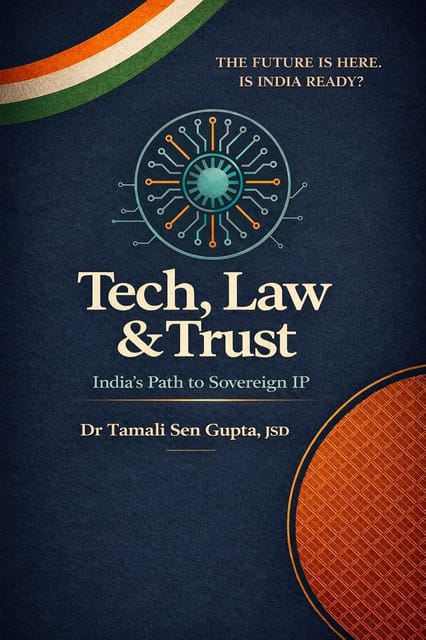
9789358919080 6a64a749860cb64b44d6b2fb Tech, Law & Trust Indias Path To Sovereign Ip https://www.midlandbookshop.com/s/607fe93d7eafcac1f2c73ea4/6a64a74a860cb64b44d6b303/71gwh6evksl-_sl1500_.jpg
Tech, Law and Trust - synopsis There are a great many books on artificial intelligence, and almost all of them are about the thing you can see: the model, the chatbot, the next release. Tech, Law and Trust: India's Path to Intellectual Property Sovereignty is about the thing you cannot see, and which decides everything, the layers beneath the model and the law that governs them. That is why, in the months since it appeared, its argument has quietly become the language in which the contest over AI is now being conducted. The claim is simple to state and hard to escape. Technological sovereignty is not won at the level of software. It is won, or surrendered, in the stack beneath it: the chips, the critical minerals, the energy, the cloud, the standards, and above all the law that governs each of those layers. I have called this the argument of the hardware beneath. Intellectual property, in this reading, is not a commercial detail but the foundational legal architecture through which a nation asserts sovereignty over technology or hands it away. Trust is the obligation that must run through the entire chain if any of it is to hold. When I wrote this, much of it read as argument. It now reads as forecast. At the Impact AI Summit in New Delhi, the Prime Minister described India building a full ecosystem from semiconductors and chip-making through quantum computing to secure data centres and a dependable energy backbone, which is the hardware beneath stated as national strategy. Within weeks the argument hardened into diplomacy. India joined Pax Silica, the framework for governing the silicon and AI supply chain, and signed the India-US AI Opportunity Partnership, whose priorities read like the book's table of contents: reliable energy for compute, critical minerals, workforce pipelines, and trusted semiconductor ecosystems. The Secretary of MeitY conceded that the copyright questions AI raises remain unsettled and before the courts. Officials floated a bargain to widen access to training data while compensating rights holders through revenue-sharing, precisely the reconstruction of IP law the book anticipated. And the Data Protection Act, which casts the individual as owner and the collector as fiduciary, supplies the exact legal grammar that binds technology, law, and trust together. When the news begins to read like a book's footnotes, the book has stopped being commentary and become a map. For India and the Global South, the subtitle is the argument. Sovereignty is usually assumed to be a function of capital, as though only the rich may be free. This book contends the opposite: that a country can contest sovereignty through legal craft, frugality, and population-scale public infrastructure rather than through a chequebook alone. That is no longer my contention only. It is the posture India carried into its BRICS chairmanship, and the spirit of the New Delhi Declaration endorsed by 91 countries and international organisations. If you are anywhere in the developing world and you want to understand how a nation builds power it was not born holding, this is the path the title names. There is a second reason the book has become unavoidable. The danger it identifies is concentration, and concentration has two faces. One is geopolitical, the question of which nations control the stack, and it filled the rooms in New Delhi. The ot

9789358919080
in stock INR 479
1 1

Tech, Law & Trust Indias Path To Sovereign Ip

ISBN: 9789358919080
₹479
₹599   (20% OFF)


Details
  • ISBN: 9789358919080
  • Author: Dr Tamali Sen Gupta Jsd
  • Publisher: Self Publication
  • Pages: 398
  • Format: Paperback
SHARE PRODUCT

Book Description

Tech, Law and Trust - synopsis There are a great many books on artificial intelligence, and almost all of them are about the thing you can see: the model, the chatbot, the next release. Tech, Law and Trust: India's Path to Intellectual Property Sovereignty is about the thing you cannot see, and which decides everything, the layers beneath the model and the law that governs them. That is why, in the months since it appeared, its argument has quietly become the language in which the contest over AI is now being conducted. The claim is simple to state and hard to escape. Technological sovereignty is not won at the level of software. It is won, or surrendered, in the stack beneath it: the chips, the critical minerals, the energy, the cloud, the standards, and above all the law that governs each of those layers. I have called this the argument of the hardware beneath. Intellectual property, in this reading, is not a commercial detail but the foundational legal architecture through which a nation asserts sovereignty over technology or hands it away. Trust is the obligation that must run through the entire chain if any of it is to hold. When I wrote this, much of it read as argument. It now reads as forecast. At the Impact AI Summit in New Delhi, the Prime Minister described India building a full ecosystem from semiconductors and chip-making through quantum computing to secure data centres and a dependable energy backbone, which is the hardware beneath stated as national strategy. Within weeks the argument hardened into diplomacy. India joined Pax Silica, the framework for governing the silicon and AI supply chain, and signed the India-US AI Opportunity Partnership, whose priorities read like the book's table of contents: reliable energy for compute, critical minerals, workforce pipelines, and trusted semiconductor ecosystems. The Secretary of MeitY conceded that the copyright questions AI raises remain unsettled and before the courts. Officials floated a bargain to widen access to training data while compensating rights holders through revenue-sharing, precisely the reconstruction of IP law the book anticipated. And the Data Protection Act, which casts the individual as owner and the collector as fiduciary, supplies the exact legal grammar that binds technology, law, and trust together. When the news begins to read like a book's footnotes, the book has stopped being commentary and become a map. For India and the Global South, the subtitle is the argument. Sovereignty is usually assumed to be a function of capital, as though only the rich may be free. This book contends the opposite: that a country can contest sovereignty through legal craft, frugality, and population-scale public infrastructure rather than through a chequebook alone. That is no longer my contention only. It is the posture India carried into its BRICS chairmanship, and the spirit of the New Delhi Declaration endorsed by 91 countries and international organisations. If you are anywhere in the developing world and you want to understand how a nation builds power it was not born holding, this is the path the title names. There is a second reason the book has become unavoidable. The danger it identifies is concentration, and concentration has two faces. One is geopolitical, the question of which nations control the stack, and it filled the rooms in New Delhi. The ot

User reviews

  0/5