Shop No.20, Aurobindo Palace Market, Hauz Khas, Near Church +91 9818282497 | 011 26867121 110016 New Delhi IN
Midland The Book Shop ™
Shop No.20, Aurobindo Palace Market, Hauz Khas, Near Church +91 9818282497 | 011 26867121 New Delhi, IN
+919871604786 https://www.midlandbookshop.com/s/607fe93d7eafcac1f2c73ea4/69591829db7aed90e0608dfb/without-tag-line-480x480.png" [email protected]
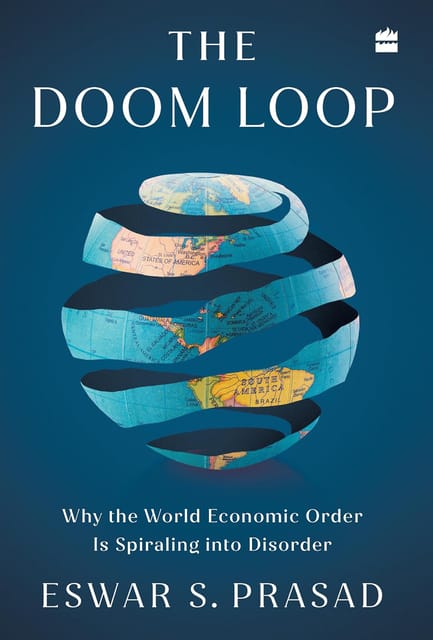
9789373074771 6a64a72e860cb64b44d6b281 The Doom Loop Why The World Economic Order Is Spiraling Into Disorder https://www.midlandbookshop.com/s/607fe93d7eafcac1f2c73ea4/6a64a731860cb64b44d6b289/81uf6qrkwol-_sl1500_.jpg

Globalization and its institutions have failed to adapt to today's political-economic realities. What went wrong, and how can we reverse our descent into chaos?

The US, once the world's undisputed superpower, is losing its dominant position. Rising economies like China and India increasingly exert their influence, the West's share of global GDP consistently declines, and America's rules-based system risks becoming irrelevant. In business, competition brings efficiency, balance, and innovation. But in the marketplace for global power, things look rather different.

In The Doom Loop, acclaimed economist Eswar S. Prasad argues that the very forces expected to stabilize the world order are fueling disarray. Instead of promoting shared prosperity, globalization has deepened inequality in many countries, stoked political backlash, and prompted escalating trade wars. Economic institutions like the International Monetary Fund and the World Trade Organization, founded to foster cooperation, have failed to adapt to twenty-first-century realities. The ascent of 'middle powers' like South Africa, Brazil, and Indonesia once suggested a stable multipolar future; but today, such economies are forced to pick sides in an intensifying US-China struggle for hegemony.

In clear-eyed, bracing prose, Prasad contends that we are caught in a destructive feedback loop between economics, domestic politics, and geopolitics. As instability becomes the status quo, we need radical new solutions to reinvigorate the world economy, prioritize common aspirations, and reverse our downward spiral into disaster.

About the Author

Eswar S. Prasad is Nandlal P. Tolani Senior Professor of Trade Policy and Professor of Economics at Cornell University, and a senior fellow at the Brookings Institution. His publications include The Future of Money, a Book of the Year in the Financial Times, The Economist, Foreign Affairs and The Week.

9789373074771
in stock INR 799
1 1

The Doom Loop Why The World Economic Order Is Spiraling Into Disorder

ISBN: 9789373074771
₹799
₹999   (20% OFF)


Details
  • ISBN: 9789373074771
  • Author: Eswar S Prasad
  • Publisher: Harper Collins
  • Pages: 368
  • Format: Hardback
SHARE PRODUCT

Book Description

Globalization and its institutions have failed to adapt to today's political-economic realities. What went wrong, and how can we reverse our descent into chaos?

The US, once the world's undisputed superpower, is losing its dominant position. Rising economies like China and India increasingly exert their influence, the West's share of global GDP consistently declines, and America's rules-based system risks becoming irrelevant. In business, competition brings efficiency, balance, and innovation. But in the marketplace for global power, things look rather different.

In The Doom Loop, acclaimed economist Eswar S. Prasad argues that the very forces expected to stabilize the world order are fueling disarray. Instead of promoting shared prosperity, globalization has deepened inequality in many countries, stoked political backlash, and prompted escalating trade wars. Economic institutions like the International Monetary Fund and the World Trade Organization, founded to foster cooperation, have failed to adapt to twenty-first-century realities. The ascent of 'middle powers' like South Africa, Brazil, and Indonesia once suggested a stable multipolar future; but today, such economies are forced to pick sides in an intensifying US-China struggle for hegemony.

In clear-eyed, bracing prose, Prasad contends that we are caught in a destructive feedback loop between economics, domestic politics, and geopolitics. As instability becomes the status quo, we need radical new solutions to reinvigorate the world economy, prioritize common aspirations, and reverse our downward spiral into disaster.

About the Author

Eswar S. Prasad is Nandlal P. Tolani Senior Professor of Trade Policy and Professor of Economics at Cornell University, and a senior fellow at the Brookings Institution. His publications include The Future of Money, a Book of the Year in the Financial Times, The Economist, Foreign Affairs and The Week.

User reviews

  0/5