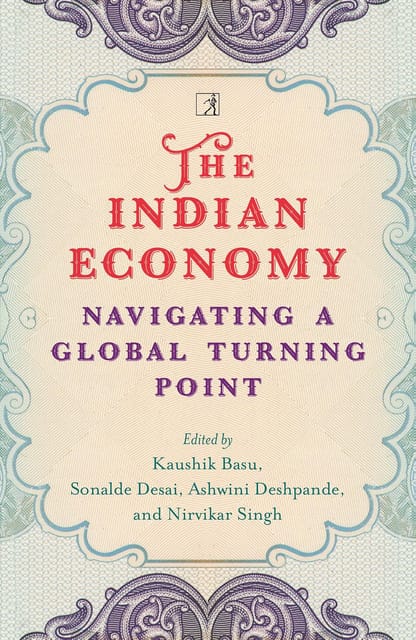
India stands at a crossroads. With a population of 1.4 billion, the world s fifth-largest economy, and a geopolitical moment that creates the potential for it to be a preferred destination for investment flowing away from China, the country has rarely faced such a confluence of opportunity and peril. A generation after liberali-zation transformed its economy, India is again confronting a turning point shaped by artificial intelligence, fractured globalization, climate risk, youth unemploy-ment, rising inequality, and a changing world order. This ambitious collection of-fers an assessment of where India stands and what it must do next and examines India s development journey from the early decades of planning and the command-ing role of the state, through the liberalization of the 1990s, to the unresolved di-lemmas of today s lower-middle-income market economy.
Threading through contributions from leading economists, business leaders, and policy thinkers is a single pressing question: can India convert its demographic scale, technological capabilities, entrepreneurial energy, and geopolitical opening into a model of development that creates good jobs, expands human capabilities, strengthens institutions, and shares the gains of globalization and technology more widely?
Neither triumphalist nor despairing, The Indian Economy: Navigating a Global Turning Point delivers the rigorous, evidence-based analysis this pivotal moment demands. It is essential reading for students, scholars, policymakers, business leaders, and anyone who believes that understanding India s economy is insepara-ble from understanding the future of the world.
Kaushik Basu is an Indian economist who was the Chief Economist of the World Bank from 2012 to 2016. He is the C. Marks Professor of International Studies and Professor of Economics at Cornell Univer-sity. From 2009 to 2012, during the UPA government's second term, Basu served as the Chief Economic Adviser to the Government of India.
Sonalde Desai is a sociologist and demographer. She is a Distin-guished University Professor of Sociology at the University of Mary-land, College Park and a professor at the National Council of Applied Economic Research, where she serves as the first direction of the Na-tional Data Innovation Centre.
Ashwini Deshpande is Professor and Head, Department of Econom-ics, and Founding Director, Centre for Economic Data and Analysis (CEDA) at Ashoka University, India.
Nirvikar Singh is Distinguished Professor of Economics at the Uni-versity of California, Santa Cruz (UCSC). He held the Sarbjit Singh Aurora Chair of Sikh and Punjabi Studies from 2010 to 2020, and also previously led its South Asian Studies Initiative.

India stands at a crossroads. With a population of 1.4 billion, the world s fifth-largest economy, and a geopolitical moment that creates the potential for it to be a preferred destination for investment flowing away from China, the country has rarely faced such a confluence of opportunity and peril. A generation after liberali-zation transformed its economy, India is again confronting a turning point shaped by artificial intelligence, fractured globalization, climate risk, youth unemploy-ment, rising inequality, and a changing world order. This ambitious collection of-fers an assessment of where India stands and what it must do next and examines India s development journey from the early decades of planning and the command-ing role of the state, through the liberalization of the 1990s, to the unresolved di-lemmas of today s lower-middle-income market economy.
Threading through contributions from leading economists, business leaders, and policy thinkers is a single pressing question: can India convert its demographic scale, technological capabilities, entrepreneurial energy, and geopolitical opening into a model of development that creates good jobs, expands human capabilities, strengthens institutions, and shares the gains of globalization and technology more widely?
Neither triumphalist nor despairing, The Indian Economy: Navigating a Global Turning Point delivers the rigorous, evidence-based analysis this pivotal moment demands. It is essential reading for students, scholars, policymakers, business leaders, and anyone who believes that understanding India s economy is insepara-ble from understanding the future of the world.
Kaushik Basu is an Indian economist who was the Chief Economist of the World Bank from 2012 to 2016. He is the C. Marks Professor of International Studies and Professor of Economics at Cornell Univer-sity. From 2009 to 2012, during the UPA government's second term, Basu served as the Chief Economic Adviser to the Government of India.
Sonalde Desai is a sociologist and demographer. She is a Distin-guished University Professor of Sociology at the University of Mary-land, College Park and a professor at the National Council of Applied Economic Research, where she serves as the first direction of the Na-tional Data Innovation Centre.
Ashwini Deshpande is Professor and Head, Department of Econom-ics, and Founding Director, Centre for Economic Data and Analysis (CEDA) at Ashoka University, India.
Nirvikar Singh is Distinguished Professor of Economics at the Uni-versity of California, Santa Cruz (UCSC). He held the Sarbjit Singh Aurora Chair of Sikh and Punjabi Studies from 2010 to 2020, and also previously led its South Asian Studies Initiative.
Subscribe to get Email Updates!
Thanks for subscribing.
Your response has been recorded.
"We Believe In The Power of Books" Our mission is to make books accessible to everyone, and to cultivate a culture of reading and learning. We strive to provide a wide range of books, from classic literature, sci-fi and fantasy, to graphic novels, biographies and self-help books, so that everyone can find something to read.
Whether you’re looking for your next great read, a gift for someone special, or just browsing, Midland is here to make your book-buying experience easy and enjoyable.
(2).png)