The passing of the age of the dinosaurs allowed mammals to become ascendant. But mammals have a much deeper history. They – or, more precisely, we – originated around the same time as the dinosaurs, over 200 million years ago; mammal roots lie even further back, some 325 million years.
Over these immense stretches of geological time, mammals developed their trademark features: hair, keen senses of smell and hearing, big brains and sharp intelligence, fast growth and warm-blooded metabolism, a distinctive line-up of teeth (canines, incisors, premolars, molars), mammary glands that mothers use to nourish their babies with milk, qualities that have underlain their success story.
Out of this long and rich evolutionary history came the mammals of today, including our own species and our closest cousins. But today’s 6,000 mammal species - the egg-laying monotremes including the platypus, marsupials such as kangaroos and koalas that raise their tiny babies in pouches, and placentals like us, who give birth to well-developed young – are simply the few survivors of a once verdant family tree, which has been pruned both by time and mass extinctions.
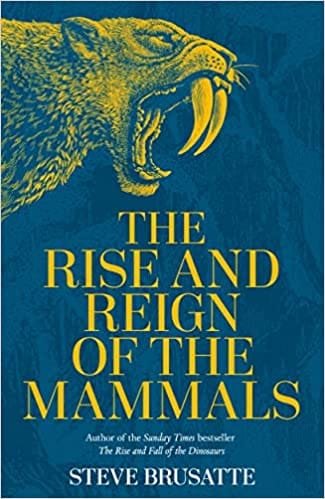
In The Rise and Reign of the Mammals, palaeontologist Steve Brusatte weaves together the history and evolution of our mammal forebears with stories of the scientists whose fieldwork and discoveries underlie our knowledge, both of iconic mammals like the mammoths and sabre-toothed tigers of which we have all heard, and of fascinating species that few of us are aware of.
For what we see today is but a very limited range of the mammals that have existed; in this fascinating and ground-breaking book, Steve Brusatte tells their – and our – story.
About the Author
Professor Steve Brusatte is a palaeontologist on the faculty of the School of GeoSciences at the University of Edinburgh in Scotland. He grew up in the Midwestern United States and has a BS in Geophysical Sciences from the University of Chicago, MSc in Palaeobiology from the University of Bristol, and PhD in Earth and Environmental Sciences from Columbia University in New York. Steve is widely recognized as one of the leading palaeontologists of his generation. He has written over one hundred and fifty peer-reviewed scientific papers during his 15 years of research in the field, named and described over a dozen new species of dinosaurs and mammals, and led groundbreaking studies on how dinosaurs rose to dominance and went extinct and how mammals replaced them afterwards. Among his particular research interests are the evolutionary transition between dinosaurs and birds and the rise of placental mammals, and he is a noted specialist on the anatomy, genealogy, and evolution of the carnivorous dinosaurs like Tyrannosaurus and Velociraptor. His 2018 book, The Rise and Fall of the Dinosaurs was a Sunday Times bestseller, and he is the science consultant for Jurassic World 3, the forthcoming film in the Jurassic Park franchise.













 +91 9818282497