Shop No.20, Aurobindo Palace Market, Hauz Khas, Near Church +91 9818282497 | 011 26867121 110016 New Delhi IN
Midland The Book Shop ™
Shop No.20, Aurobindo Palace Market, Hauz Khas, Near Church +91 9818282497 | 011 26867121 New Delhi, IN
+919871604786 https://www.midlandbookshop.com/s/607fe93d7eafcac1f2c73ea4/69591829db7aed90e0608dfb/without-tag-line-480x480.png" [email protected]
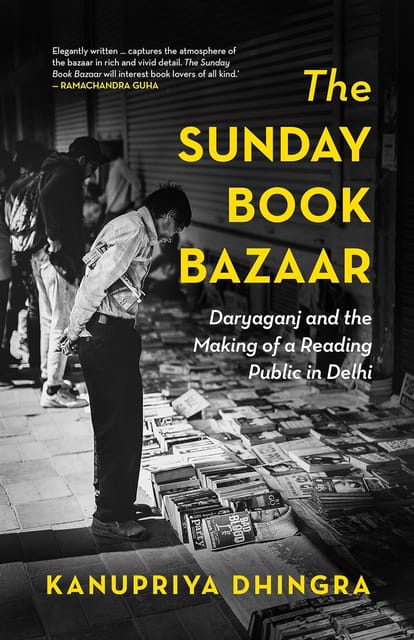
9789363365032 6a3253e32737441715c8aad3 The Sunday Book Bazaar https://www.midlandbookshop.com/s/607fe93d7eafcac1f2c73ea4/6a325280aed7bc893b91f218/813ee8qcsll-_sl1500_.jpg

‘Elegantly written… Should be mandatory reading for citizens of Delhi who wish to know their city better—even, or especially, those who do not buy or read books themselves.’—Ramachandra Guha

Every Sunday, in the heart of Old Delhi, a footpath became a bookshop.

For decades, the Daryaganj Sunday Book Bazaar drew students, collectors, families, tourists and lifelong shauqeen to its pavement piles: textbooks, comics, rare editions, pirated bestsellers, forgotten magazines, discarded libraries, and books that seemed to find their readers by accident. Built by migrant booksellers, sustained by bargain-hunters and bibliophiles, and shaped by the rhythms of the street, the bazaar became one of Delhi’s most beloved cultural institutions.

In The Sunday Book Bazaar, Kanupriya Dhingra traces the life of this remarkable market—from its roots in the book cultures of Shahjahanabad and Daryaganj to its rise as a second-hand book paradise, and from its legal battles and evictions to its relocation in Mahila Haat.

Combining urban history, fieldwork, memoir and literary affection, she follows the books, booksellers and readers who made the bazaar a parallel world of print: informal, unpredictable, deeply democratic, and impossible to replace.

At once urban history, ethnography, memoir, and a love letter to second-hand books, The Sunday Book Bazaar asks what makes a market more than a place of commerce. Who gets to read? Who gets to sell? Who gets to occupy public space? And what does a city lose when it tidies away the unruly, democratic spaces where its readers first learn to browse, bargain, linger and belong?

About the Author

Dr Kanupriya Dhingra researches book history, print cultures, oral history, and urban studies, with a special focus on Delhi’s parallel book markets. Her doctoral work at SOAS, University of London, supported by the Felix Scholarship and the SOAS Fieldwork Grant, examined Daryaganj’s book culture through extensive interviews with booksellers and readers. She has written for Comparative Critical Studies, The Caravan, Seminar, Scroll, and Himal SouthAsian, and has spoken at institutions including Oxford, the British Library, Jadavpur University, Jamia Millia Islamia, and the University of Delhi. She also writes and translates poetry and fiction from Hindi, Punjabi, and Urdu.

9789363365032
in stock INR 479
1 1

The Sunday Book Bazaar

ISBN: 9789363365032
₹479
₹599   (20% OFF)


Details
  • ISBN: 9789363365032
  • Author: Kanupriya Dhingra
  • Format: Paperback
  • Publisher: Speaking Tiger Books
  • Publication Date: 24 June 2026
SHARE PRODUCT

Book Description

‘Elegantly written… Should be mandatory reading for citizens of Delhi who wish to know their city better—even, or especially, those who do not buy or read books themselves.’—Ramachandra Guha

Every Sunday, in the heart of Old Delhi, a footpath became a bookshop.

For decades, the Daryaganj Sunday Book Bazaar drew students, collectors, families, tourists and lifelong shauqeen to its pavement piles: textbooks, comics, rare editions, pirated bestsellers, forgotten magazines, discarded libraries, and books that seemed to find their readers by accident. Built by migrant booksellers, sustained by bargain-hunters and bibliophiles, and shaped by the rhythms of the street, the bazaar became one of Delhi’s most beloved cultural institutions.

In The Sunday Book Bazaar, Kanupriya Dhingra traces the life of this remarkable market—from its roots in the book cultures of Shahjahanabad and Daryaganj to its rise as a second-hand book paradise, and from its legal battles and evictions to its relocation in Mahila Haat.

Combining urban history, fieldwork, memoir and literary affection, she follows the books, booksellers and readers who made the bazaar a parallel world of print: informal, unpredictable, deeply democratic, and impossible to replace.

At once urban history, ethnography, memoir, and a love letter to second-hand books, The Sunday Book Bazaar asks what makes a market more than a place of commerce. Who gets to read? Who gets to sell? Who gets to occupy public space? And what does a city lose when it tidies away the unruly, democratic spaces where its readers first learn to browse, bargain, linger and belong?

About the Author

Dr Kanupriya Dhingra researches book history, print cultures, oral history, and urban studies, with a special focus on Delhi’s parallel book markets. Her doctoral work at SOAS, University of London, supported by the Felix Scholarship and the SOAS Fieldwork Grant, examined Daryaganj’s book culture through extensive interviews with booksellers and readers. She has written for Comparative Critical Studies, The Caravan, Seminar, Scroll, and Himal SouthAsian, and has spoken at institutions including Oxford, the British Library, Jadavpur University, Jamia Millia Islamia, and the University of Delhi. She also writes and translates poetry and fiction from Hindi, Punjabi, and Urdu.
User reviews

  0/5