
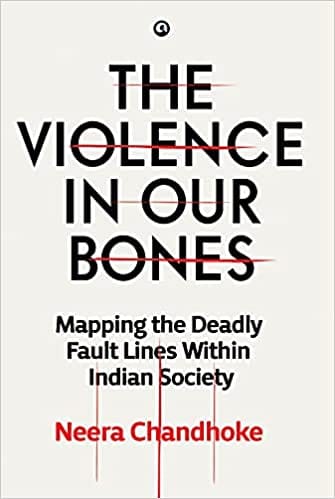
THE VIOLENCE IN OUR BONES: MAPPING THE DEADLY FAULT LINES WITHIN INDIAN SOCIETY
ISBN:
9789390652426
₹559
₹699
(20% OFF)
Back In Stock Shortly - Fill The Book Request Form
Details
- ISBN: 9789390652426
- Author: Neera Chandhoke
- Publisher: Aleph Book Company
- Pages: 288
- Format: Hardback
Book Description
The Buddha, Ashoka, Gandhi—the three greatest Indians who ever lived—were emblematic of non-violence. Yet, paradoxically, their country of origin is one of the most violent places on earth. Do ‘we, the people of India’ have violence in our bones? This work explores different aspects of our society to answer the question. Despite a blood-soaked Partition coupled with many other challenges that all emerging democracies have had to negotiate, India’s record in upholding the democratic values enshrined in its Constitution has been impressive. Yet, violence remains an inextricable part of everyday life. Parts of the country are rocked by ‘low-intensity’ operations against various insurgencies. Our society is also scarred by caste violence, communal riots, and viciousness against women, children, the transgender community, and minorities. The country’s large size, a highly differentiated population, uneven economic development, linguistic differences, regional imbalances, class and caste hierarchies, the politicizing of religious identities, appropriation of tribal lands, agrarian distress, joblessness, poverty, and deep inequality all breed frustration. Violence underlies almost every social and political interaction within Indian society, from the violence of everyday life to the brutal actions of the state or those ranged against the state. The Violence in Our Bones maps the assorted kinds of violence in India, and explores why, even as a successful democracy, violence continues to be endemic in the nation.
About the Author
Neera Chandhoke taught Political Science at the University of Delhi. She is a Distinguished Fellow, Centre for Equity Studies, Delhi. She writes about civil society, secularism, revolutionary violence, and democracy. Her latest work is Rethinking Pluralism, Secularism and Tolerance: Anxieties of Coexistence.
Related Books


₹639
₹799
(20% OFF)




 +91 9818282497
(2).png)