
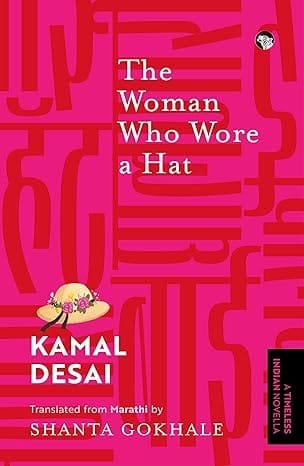
The Woman Who Wore A Hat
ISBN:
9789363360815
₹319
₹399
(20% OFF)
Back In Stock Shortly - Fill The Book Request Form
Details
- ISBN: 9789363360815
- Author: Kamal Desai
- Publisher: Speaking Tiger
- Pages: 128
- Format: Paperback
Book Description
In a house with an octagonal drawing room, a group of men gather night after night to talk, drink, and circle around their emptiness. The air is thick with boredom, guilt, and the ghosts of the past. Into this closed, suffocating world walks a young woman wearing a hat garlanded with flowers. She says she wants to make an animated film, that she has lost her memory, that she is looking for capital—and perhaps for herself. Through her, Kamal Desai creates a powerful portrait of women who refuse to be confined by expectations—as wives, daughters, and mothers—and reach for something beyond endurance, towards self-definition.
First published in Marathi in 1975, The Woman Who Wore a Hat is a landmark of Indian feminist fiction. In its quiet yet piercing way, it dismantles the boundaries between the masculine and feminine, sanity and rebellion, belonging and exile, memory and selfhood. With wit, lyricism, and sharp psychological insight, Desai traces a woman’s insistence on choosing her own meaning in a world that seeks to name and contain her.
Shanta Gokhale’s elegant translation brings this daring, introspective novel to a new generation of readers—one that continues to ask what it means for a woman to be free.
About the Author
Kamal Desai (1928-2011) was a renowned Marathi writer. Born in Belgaum district of Karnataka, she went to Mumbai to pursue her postgraduate studies in Marathi, after which she worked as a professor in various colleges in Maharashtra. She began her writing career in 1955 and published two collections of short stories and three novels, best known among them, Hat Ghalnari Bai (The Woman Who Wore a Hat).
Shanta Gokhale has worked as a lecturer in English at Elphinstone College and H.R. College of Commerce, as a sub-editor with Femina, as a P.R. Executive with Glaxo Laboratories and as arts editor with the Times of India. Gokhale has written three novels in Marathi, two of which have won the Maharashtra State Award for the best novel of the year, a memoir, One Foot on the Ground, and has translated novels, non-fiction and plays. She was awarded the Lifetime Achievement Award at Tata Literature Live in 2019, and the Vani Prakashan Award in 2025.







 +91 9818282497
(2).png)