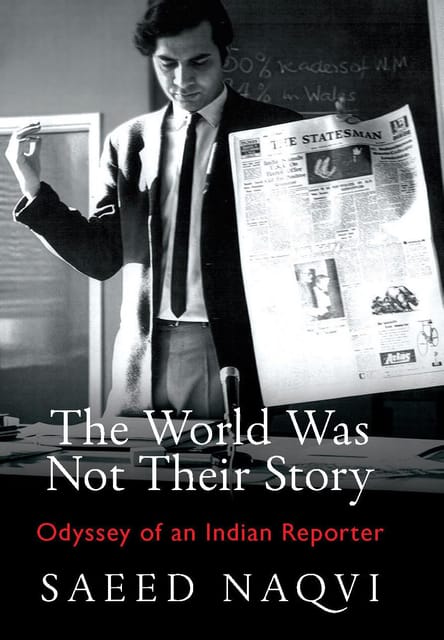
The memoirs of one of India s most celebrated journalists whose work over six decades and across 110 countries was driven by the conviction that India must see the world with its own eyes.
With few correspondents overseas, independent India s newspapers have depended on agencies and publications in London or Washington, content to wear the blinkers of the West. The world, in other words, was not their story.Saeed Naqvi spent his sixty-year career trying to make it one. His journey began at The Statesman in the 1960s, where he made his name with an exclusive on the Beatles in Rishikesh and won Jayaprakash Narayan s confidence while reporting the Bihar movement. Later, at The Indian Express, his association with Ramnath Goenka drew him into the paper s battles and politics, especially during the Emergency.
After leaving The Indian Express in 1984, Naqvi founded the news agency World Report to put Indian journalists at the scene of global events. His reporting took him to 110 countries, often as the only Indian journalist there. He covered the 1971 JVP insurrection in Sri Lanka, the Sino-Vietnamese War and the TWA 847 hijacking in Beirut; saw Nelson Mandela walk free; interviewed Fidel Castro, Mikhail Gorbachev, Muammar Gaddafi and Israeli prime ministers; and reported from Iran during the Islamic revolution and Iraq during Operation Desert Storm. From Rwanda, Sudan, Haiti and Kosovo to Gaza, Kabul, Nicaragua and Northern Ireland, he went where Indian newspapers rarely sent their reporters. In the years before mobile phones, every such assignment was shaped by constraints beyond the reporter s control, demanding resourcefulness and a fair measure of luc

The memoirs of one of India s most celebrated journalists whose work over six decades and across 110 countries was driven by the conviction that India must see the world with its own eyes.
With few correspondents overseas, independent India s newspapers have depended on agencies and publications in London or Washington, content to wear the blinkers of the West. The world, in other words, was not their story.Saeed Naqvi spent his sixty-year career trying to make it one. His journey began at The Statesman in the 1960s, where he made his name with an exclusive on the Beatles in Rishikesh and won Jayaprakash Narayan s confidence while reporting the Bihar movement. Later, at The Indian Express, his association with Ramnath Goenka drew him into the paper s battles and politics, especially during the Emergency.
After leaving The Indian Express in 1984, Naqvi founded the news agency World Report to put Indian journalists at the scene of global events. His reporting took him to 110 countries, often as the only Indian journalist there. He covered the 1971 JVP insurrection in Sri Lanka, the Sino-Vietnamese War and the TWA 847 hijacking in Beirut; saw Nelson Mandela walk free; interviewed Fidel Castro, Mikhail Gorbachev, Muammar Gaddafi and Israeli prime ministers; and reported from Iran during the Islamic revolution and Iraq during Operation Desert Storm. From Rwanda, Sudan, Haiti and Kosovo to Gaza, Kabul, Nicaragua and Northern Ireland, he went where Indian newspapers rarely sent their reporters. In the years before mobile phones, every such assignment was shaped by constraints beyond the reporter s control, demanding resourcefulness and a fair measure of luc
Subscribe to get Email Updates!
Thanks for subscribing.
Your response has been recorded.
"We Believe In The Power of Books" Our mission is to make books accessible to everyone, and to cultivate a culture of reading and learning. We strive to provide a wide range of books, from classic literature, sci-fi and fantasy, to graphic novels, biographies and self-help books, so that everyone can find something to read.
Whether you’re looking for your next great read, a gift for someone special, or just browsing, Midland is here to make your book-buying experience easy and enjoyable.
(2).png)