An economic way of thinking about the gender issues confronting women around the world
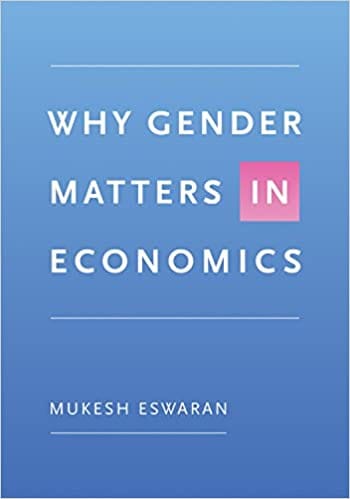
Gender matters in economics-for even with today's technology, fertility choices, market opportunities, and improved social norms, economic outcomes for women remain markedly worse than for men. Drawing on insights from feminism, postmodernism, psychology, evolutionary biology, Marxism, and politics, this textbook provides a rigorous economic look at issues confronting women throughout the world-including nonmarket scenarios, such as marriage, family, fertility choice, and bargaining within households, as well as market areas, like those pertaining to labor and credit markets and globalization.
Mukesh Eswaran examines how women’s behavioral responses in economic situations and their bargaining power within the household differ from those of men. Eswaran then delves into the far-reaching consequences of these differences in both market and nonmarket domains. The author considers how women may be discriminated against in labor and credit markets, how their family and market circumstances interact, and how globalization has influenced their lives. Eswaran also investigates how women have been empowered through access to education, credit, healthcare, and birth control; changes in ownership laws; the acquisition of suffrage; and political representation. Throughout, Eswaran applies sound economic analysis and new modeling approaches, and each chapter concludes with exercises and discussion questions.
This textbook gives readers the necessary tools for thinking about gender from an economic perspective.
- Addresses economic issues for women throughout the world, in both developed and developing countries
- Looks at both market and nonmarket domains
- Requires only a background in basic economic principles
- Includes the most recent research on the economics of gender in a range of areas
- Concludes each chapter with exercises and discussion questions
Review
"Winner of the 2015 PROSE Award in Textbook/Social Sciences, Association of American Publishers"
"One of Choice's Outstanding Academic Titles for 2015"
"Providing an accessible textbook-style survey of this emerging field, Mukesh Eswaran's Why Gender Matters in Economics plugs a gaping hole in the discipline. Drawing on insights not only from feminism but also from evolutionary biology, anthropology, psychology, politics and Marxism, Eswaran seeks to answer questions of interest to us all."---Victoria Bateman, Times Higher Education
"[Why Gender Matters in Economics] provides a practical understanding of how economic reasoning informs discussions around such topics as the balance of power in households, labor markets, wealth, credit markets, fertility and health care, marriage, suffrage, and empowerment. . . . This book is a comprehensive and discerning work that should provide readers with the context and understanding to more effectively comprehend the substantive economic role of gender." - Choice
"A rich trove of information about what are commonly though of as ‘women's issues’ in economics."---Julie A. Nelson, Journal of Economic Literature
"Why Gender Matters in Economics is an excellent combination of textbook and general audience book, a suitable hybrid for the subject matter. This synthesis is well executed and makes the book useful to a wide audience."---Mark Fabian, Economic Record
Review
"This thoughtful, energetic, creative, and engaging book does a terrific job reviewing and explaining some of the most interesting economic research on gender in recent years. It fills an important gap in the gender and economics literature."-Nancy Folbre, professor emeritus of economics, University of Massachusetts, Amherst
"Providing a comprehensive view of the economic lives of women, Why Gender Matters in Economics argues that women are systematically disadvantaged relative to men in a number of dimensions and offers policy ideas regarding how women might be more empowered. The book's approach is novel and synthesizes recent research results."-Joyce P. Jacobsen, Wesleyan University
From the Inside Flap
"This thoughtful, energetic, creative, and engaging book does a terrific job reviewing and explaining some of the most interesting economic research on gender in recent years. It fills an important gap in the gender and economics literature."--Nancy Folbre, professor emeritus of economics, University of Massachusetts, Amherst
"Providing a comprehensive view of the economic lives of women, Why Gender Matters in Economics argues that women are systematically disadvantaged relative to men in a number of dimensions and offers policy ideas regarding how women might be more empowered. The books approach is novel and synthesizes recent research results."--Joyce P. Jacobsen, Wesleyan University
From the Back Cover
"This thoughtful, energetic, creative, and engaging book does a terrific job reviewing and explaining some of the most interesting economic research on gender in recent years. It fills an important gap in the gender and economics literature."--Nancy Folbre, professor emeritus of economics, University of Massachusetts, Amherst
"Providing a comprehensive view of the economic lives of women, Why Gender Matters in Economics argues that women are systematically disadvantaged relative to men in a number of dimensions and offers policy ideas regarding how women might be more empowered. The book's approach is novel and synthesizes recent research results."--Joyce P. Jacobsen, Wesleyan University
About the Author
Mukesh Eswaran is a professor in the Vancouver School of Economics at the University of British Columbia.













 +91 9818282497
(2).png)