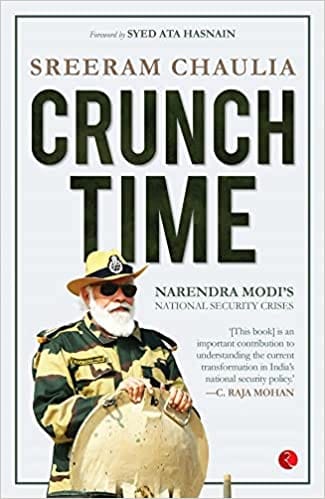
Is India too defensive and tolerant when its core national security is threatened? Has it been a ‘soft state’ in responding to terrorist provocations from Pakistan and territorial encroachments from China? Does India lack a strategic culture of raising the costs of aggression by its two principal adversaries? The past record of the Indian state has been questioned on such grounds. But this changed during the prime ministership of Narendra Modi. Guided by a ‘security first’ vision and the doctrine of ‘offensive defense’, his government sought to alter the strategic calculus of India’s opponents by credibly demonstrating a willingness to use commensurate military force and apply diplomatic and economic pressure. Crunch Time: Narendra Modi’s National Security Crises gives a comprehensive analysis of how ‘new India’ conducted itself during episodes of major national security crises. It is a testament to how a strong-willed political leadership with mass social support can transform a country’s strategic culture and deter its foes.
Review
In Crunch Time, Sreeram Chaulia examines the Indian effort under Prime Minister Narendra Modi to change the terms of military engagement with Pakistan and China. In analysing four military crises under the Modi government, two each with Pakistan and China, Chaulia delineates a consequential transition in India’s strategic culture, from military/political diffidence to self-assurance and assertiveness. Crunch Time is an important contribution to understanding the current transformation in India’s national security policy.
—C. Raja Mohan, Foreign Affairs Columnist, The Indian Express and Visiting Research Professor, Institute of South Asian Studies, National University of Singapore
Sreeram Chaulia has given a scholarly account of some of the distinct features of India’s foreign and national security policies adopted by Prime Minister Narendra Modi. The focus is naturally on the firm response to the Chinese intrusion in Ladakh in 2020 and the air strike on the Balakot terrorist camp in Pakistan in 2019. These responses have gone a long way in correcting misperceptions about India being incapable of responding in a firm, mature and measured manner to threats to its national security from across its borders.
—G. Parthasarathy, Chancellor, Central University of Jammu and former Indian High Commissioner to Pakistan
There is no doubt that Prime Minister Narendra Modi has had a big impact on India’s national security posture. Sreeram Chaulia has done a creditable job of collating the evidence and presenting a lucid account of the drivers of Modi’s policies and the impact they’ve had on India’s international profile.
—Indrani Bagchi, Diplomatic Editor, The Times of India
A fascinating account of how Prime Minister Narendra Modi has transformed India’s strategic outlook to help make the country more confident and secure. The chapters are clearly structured and lucidly written, with the focus being on the major strategic developments in the period since Modi’s ascent to power. The largely laudatory account is an essential reading to understand how Modi thinks and acts.
—Brahma Chellaney, Professor of Strategic Studies, Centre for Policy Research
About the Author
Sreeram Chaulia is a social scientist and opinion maker on international issues. He is professor and dean at the Jindal School of International Affairs of O.P. Jindal Global University, Sonipat. He has previously authored five books, including Modi Doctrine: The Foreign Policy of India’s Prime Minister (2016) and Trumped: Emerging Powers in a Post-American World (2019). He is a leading opinion columnist on international issues in newspapers and magazines in both Hindi and English, and a regular analyst of world politics on radio and television.
He tweets on global current affairs @sreeramchaulia.





 +91 9818282497
(2).png)