Shop No.20, Aurobindo Palace Market, Hauz Khas, Near Church +91 9818282497 | 011 26867121 110016 New Delhi IN
Midland The Book Shop ™
Shop No.20, Aurobindo Palace Market, Hauz Khas, Near Church +91 9818282497 | 011 26867121 New Delhi, IN
+919871604786 https://www.midlandbookshop.com/s/607fe93d7eafcac1f2c73ea4/69591829db7aed90e0608dfb/without-tag-line-480x480.png" [email protected]
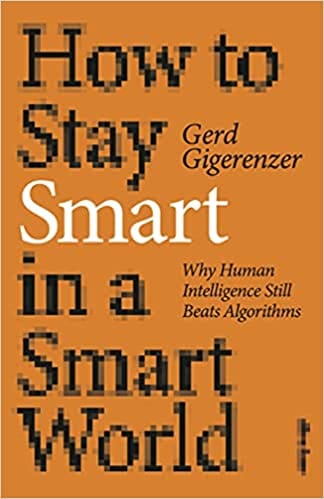
9780241567432 622b3bdfcb29b00754c60484 How To Stay Smart In A Smart World Why Human Intelligence Still Beats Algorithms https://www.midlandbookshop.com/s/607fe93d7eafcac1f2c73ea4/622b3cb5921cd5f6e7efc8b4/41ssj4jdmvs-_sx322_bo1-204-203-200_.jpg

An essential guide to navigating our data-driven world, from the renowned psychologist and author of Risk Savvy

Is more data always a good thing?
Do algorithms really make better decisions than humans?
Can we stay in control in an increasingly automated world?

Drawing on decades of research into decision-making under uncertainty, Gerd Gigerenzer makes a compelling case for the enduring importance of human discernment in an automated world that we are told can - and will - replace our efforts.

From dating apps and self-driving cars to facial recognition and the justice system, the increasing presence of AI has been widely championed - but there are limitations and risks too. Humans are the greatest source of uncertainty in these situations and Gigerenzer shows how, when people are involved, trust in complex algorithms can lead to illusions of certainty that become a recipe for disaster. We need, now more than ever, to arm ourselves with knowledge about how to make better decisions in a digital age

Filled with practical examples and cutting-edge research, How to Stay Smart in a Smart World examines the growing role of AI at all levels of daily life with refreshing clarity. This book is a liferaft in a sea of information and an urgent invitation to actively shape the world in which we want to live.


Review

Enlightening, impassioned, powerful . . . exposes the hunger for autocratic power, the political naivety and the commercial chicanery that lie behind the rise of AI -- Simon Ings - The Times

Using personal anecdotes, cutting-edge research and cautionary real-world tales, Gigerenzer deftly explains the limits and dangers of technology and AI -- Chen Ly - New Scientist

Compelling . . . over many years, Gerd Gigerenzer has provided evidence that humans are smarter than economists. Now he shows that they are (where it matters) smarter than computers -- John Kay - co-author of Radical Uncertainty

One of the world's most eminent psychologists - Spectator

A fascinating invitation to keep thinking for ourselves... Vital reading for a world populated by algorithms -- Konstantinos Katsikopoulos, Professor of Behavioural Science, University of Southampton

About the Author

Gerd Gigerenzer is Director of the Harding Centre for Risk Literacy at the University of Potsdam and partner of Simply Rational: The Institute for Decisions. He is former Director of the Centre for Adaptive Behaviour and Cognition at the Max Planck Institute for Human Development and a former Professor of Psychology at the University of Chicago. He is the author of several books on heuristics and decision-making, including Risk Savvy and Reckoning with Risk.

9780241567432
out of stock INR 639
1 1

How To Stay Smart In A Smart World Why Human Intelligence Still Beats Algorithms

ISBN: 9780241567432
₹639
₹799   (20% OFF)


Back In Stock Shortly - Fill The Book Request Form

Details
  • ISBN: 9780241567432
  • Author: Gerd Gigerenzer
  • Publisher: Allen Lane
  • Pages: 320
  • Format: Paperback
SHARE PRODUCT

Book Description

An essential guide to navigating our data-driven world, from the renowned psychologist and author of Risk Savvy

Is more data always a good thing?
Do algorithms really make better decisions than humans?
Can we stay in control in an increasingly automated world?

Drawing on decades of research into decision-making under uncertainty, Gerd Gigerenzer makes a compelling case for the enduring importance of human discernment in an automated world that we are told can - and will - replace our efforts.

From dating apps and self-driving cars to facial recognition and the justice system, the increasing presence of AI has been widely championed - but there are limitations and risks too. Humans are the greatest source of uncertainty in these situations and Gigerenzer shows how, when people are involved, trust in complex algorithms can lead to illusions of certainty that become a recipe for disaster. We need, now more than ever, to arm ourselves with knowledge about how to make better decisions in a digital age

Filled with practical examples and cutting-edge research, How to Stay Smart in a Smart World examines the growing role of AI at all levels of daily life with refreshing clarity. This book is a liferaft in a sea of information and an urgent invitation to actively shape the world in which we want to live.


Review

Enlightening, impassioned, powerful . . . exposes the hunger for autocratic power, the political naivety and the commercial chicanery that lie behind the rise of AI -- Simon Ings - The Times

Using personal anecdotes, cutting-edge research and cautionary real-world tales, Gigerenzer deftly explains the limits and dangers of technology and AI -- Chen Ly - New Scientist

Compelling . . . over many years, Gerd Gigerenzer has provided evidence that humans are smarter than economists. Now he shows that they are (where it matters) smarter than computers -- John Kay - co-author of Radical Uncertainty

One of the world's most eminent psychologists - Spectator

A fascinating invitation to keep thinking for ourselves... Vital reading for a world populated by algorithms -- Konstantinos Katsikopoulos, Professor of Behavioural Science, University of Southampton

About the Author

Gerd Gigerenzer is Director of the Harding Centre for Risk Literacy at the University of Potsdam and partner of Simply Rational: The Institute for Decisions. He is former Director of the Centre for Adaptive Behaviour and Cognition at the Max Planck Institute for Human Development and a former Professor of Psychology at the University of Chicago. He is the author of several books on heuristics and decision-making, including Risk Savvy and Reckoning with Risk.
User reviews

  0/5