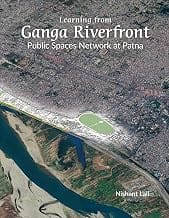
Learning from Ganga Riverfront documents Patna's landmark riverfront revitalization--a 6.5 km expanse of promenades, heritage integration, and ecological restoration--offering architects and urban planners a comprehensive study in context-sensitive, river-edge urban design.
Learning from Ganga Riverfront chronicles a unique revitalization program along the River Ganga in Patna. For a city with its back to the river--marked by isolated
ghats and disconnected development--this project proposes a comprehensive development solution addressing vital concerns such as public space, civic amenities, environmental awareness, and ecological restoration. The project connects existing fragmented open spaces into a continuous public realm along the river, aiding in religious festivities and recreation alike. The project also aims to develop
ghat prototypes that could create a cohesive typology for the river's edge, integrating heritage buildings while remaining sensitive to the local context.
Engaging a long stretch along the river, the purposed development includes 6.5 kilometers of promenades, six community, educational, and recreational buildings, food kiosks, ecological landscaping, and other public amenities. The project received $40 million in funding from the World Bank and was supported by the Ministry of Jal Shakti, Government of India. As a holistic development, the proposal promotes a walkable city, creating larger usable open spaces and attracting people from all age groups.
About the Author
Nishant Lall is an urban designer and architect from University of California Los Angeles (UCLA) with over two decades of experience in Los Angeles and Boston. Having worked on several award-winning urban projects, he set up NilaA Architecture and Urban Design in New Delhi in 2010. From 2016 to 2024, Lall was an urban design consultant to the Climate Change and Disaster Risk Management unit at World Bank India. He is a Visiting Professor of Urban Design at School of Planning and Architecture, New Delhi.












 +91 9818282497

(2).png)