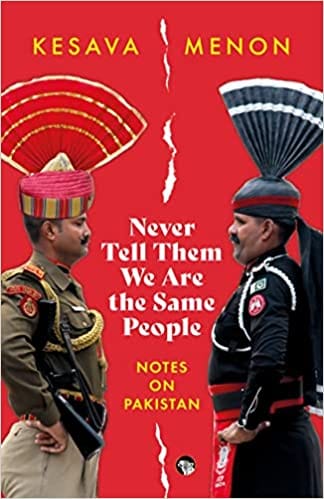
Many Indians see Pakistan and Pakistanis as irredeemably hostile. Of the rest, while some argue that, despite Partition, we’re still the same people, others don’t really know any better to have an opinion. Veteran journalist Kesava Menon offers a unique and personal perspective that pulls the third category of Indians out of their indifference, and pokes holes in the black-and-white outlook of the first and the glib optimism of the second.
Menon has been a long-time commentator on Pakistani politics, ever since his stint as The Hindu’s correspondent in Pakistan in the early 1990s, a crucial period in that country’s recent history. The Islamic hardliner and dictator Zia-ul-Haq had died in an air crash, and the future of the nation’s new experiment with democracy was at best uncertain—with Nawaz Sharif coming to office after Benazir Bhutto’s brief first run as prime minister. People were free enough to breathe easy, but yet too feeble to speak up to power. So while the army was now led by a non-fanatical professional, religious fundamentalists with little electoral clout could still openly hurl obscenities about Benazir at a PPP rally; the three-starred pioneer of anti-India jihad could personally express genuine hope for Indo-Pak friendship to the author; and a prime ministerial gala could alter its menu to accommodate a South Indian Hindu journalist who they assumed must be vegetarian.
While we see both the authoritarian and the democratic tendencies at work in Pakistan’s politics—in the 1990s, as in the decades before and since—this book contains more than just political commentary. It is also an attempt to understand the ‘idea’ of Pakistan, its sense of itself—both as a people and a nation-state—and how India ought to deal with its intractable neighbour.
Calm and lucid yet simultaneously playful and trenchant, this analysis of the culture and politics of Pakistan vis-à-vis India combines deep insight and engaging anecdotes to deliver a thoroughly entertaining take on the complex and often tumultuous relationship between the two countries.
About the Author
Kesava Menon is an analyst and writer on political affairs. He was Editor of the Malayalam newspaper Mathrubhumi for eight years until his retirement in 2017. Prior to that, between 2002 and 2009, he was an Associate Editor with The Hindu. From 1994 to 2002, he was the paper’s West Asia correspondent based in Bahrain. He was paper’s first Pakistan Correspondent from July 1990 to October 1993.



 +91 9818282497
(2).png)