Shop No.20, Aurobindo Palace Market, Hauz Khas, Near Church +91 9818282497 | 011 26867121 110016 New Delhi IN
Midland The Book Shop ™
Shop No.20, Aurobindo Palace Market, Hauz Khas, Near Church +91 9818282497 | 011 26867121 New Delhi, IN
+919871604786 https://www.midlandbookshop.com/s/607fe93d7eafcac1f2c73ea4/69591829db7aed90e0608dfb/without-tag-line-480x480.png" [email protected]
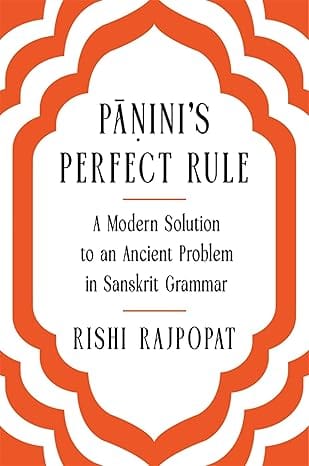
9780674305762 696638c646267294ef25ceea Paninis Perfect Rule A Modern Solution To An Ancient Problem In Sanskrit Grammar https://www.midlandbookshop.com/s/607fe93d7eafcac1f2c73ea4/696638c746267294ef25cef2/71d-r8pj5il-_sy466_.jpg

A new interpretation of a 2,500-year-old Sanskrit text upends millennia of debate and affirms an ancient linguist’s remarkably sophisticated grammatical system.

Around 500 BCE, the Indian scholar Pa?ini wrote a treatise on Sanskrit, the A??adhyayi, describing a kind of language machine: an algebraic system of rules for producing grammatically correct word forms. The enormity and elegance of that accomplishment—and the underlying computational methodology—cemented Pa?ini’s place as a founder of linguistics. Even so, centuries of commentators have insisted that there are glitches in the machine’s ability to tackle rule conflict (that is, a situation in which two or more rules are simultaneously applicable) and have responded with complex rules and tools aimed at resolving the issues apparently besetting the ancient system.

In one fell swoop, this book renders the overwhelming majority of that work obsolete. Linguist Rishi Rajpopat lays out a novel interpretation of Pa?ini’s grammar, focusing on Pa?ini’s only rule dealing with rule conflict, known as 1.4.2. Pa?ini’s Perfect Rule shows that the A??adhyayi indeed functions like a well-oiled machine, capable of handling challenges without any of the complications introduced by later scholars.

Rajpopat thus solves an ancient and important problem in Indology and linguistics that will fascinate anyone interested in how language systems—including those of computer programming—operate. In addition, Pa?ini’s Perfect Rule offers meditations on the history of the early Pa?inian tradition, its philosophy, the relationship between rule conflict and accentuation, and aspects of theoretical phonology. A nontechnical preface lays out key findings and foregrounds the deep history of Sanskrit scholarship. This volume opens new horizons for the study of Sanskrit, inviting seasoned experts and novices alike to behold its majesty.


About the Author

Rishi Rajpopat is Research Assistant Professor in the Department of Philosophy and Religious Studies at the University of Macau. His research on Pa?ini's grammar has been covered by the BBC, Daily Mail, The Telegraph, the Times of India, The Hindu, and other global news outlets. --This text refers to an out of print or unavailable edition of this title.

Review

This is a wonderfully interesting, enjoyable book on a new solution to an ancient problem of word construction in Sanskrit. As a longtime admirer of Pa?ini, I join Rishi Rajpopat in inviting general readers - not just grammarians and linguists - to the fun hidden in the great Pa?inian rules.--Amartya Sen, winner of the Nobel Prize in Economic Sciences

Pa?ini's Perfect Rule is a splendid

9780674305762
in stockINR 639
1 1
Paninis Perfect Rule A Modern Solution To An Ancient Problem In Sanskrit Grammar

Paninis Perfect Rule A Modern Solution To An Ancient Problem In Sanskrit Grammar

ISBN: 9780674305762
₹639
₹799   (20% OFF)


Details
  • ISBN: 9780674305762
  • Author: Rishi Rajpopat
  • Publisher: Harvard
  • Pages: 284
  • Format: Hardback
SHARE PRODUCT

Book Description

A new interpretation of a 2,500-year-old Sanskrit text upends millennia of debate and affirms an ancient linguist’s remarkably sophisticated grammatical system.

Around 500 BCE, the Indian scholar Pa?ini wrote a treatise on Sanskrit, the A??adhyayi, describing a kind of language machine: an algebraic system of rules for producing grammatically correct word forms. The enormity and elegance of that accomplishment—and the underlying computational methodology—cemented Pa?ini’s place as a founder of linguistics. Even so, centuries of commentators have insisted that there are glitches in the machine’s ability to tackle rule conflict (that is, a situation in which two or more rules are simultaneously applicable) and have responded with complex rules and tools aimed at resolving the issues apparently besetting the ancient system.

In one fell swoop, this book renders the overwhelming majority of that work obsolete. Linguist Rishi Rajpopat lays out a novel interpretation of Pa?ini’s grammar, focusing on Pa?ini’s only rule dealing with rule conflict, known as 1.4.2. Pa?ini’s Perfect Rule shows that the A??adhyayi indeed functions like a well-oiled machine, capable of handling challenges without any of the complications introduced by later scholars.

Rajpopat thus solves an ancient and important problem in Indology and linguistics that will fascinate anyone interested in how language systems—including those of computer programming—operate. In addition, Pa?ini’s Perfect Rule offers meditations on the history of the early Pa?inian tradition, its philosophy, the relationship between rule conflict and accentuation, and aspects of theoretical phonology. A nontechnical preface lays out key findings and foregrounds the deep history of Sanskrit scholarship. This volume opens new horizons for the study of Sanskrit, inviting seasoned experts and novices alike to behold its majesty.


About the Author

Rishi Rajpopat is Research Assistant Professor in the Department of Philosophy and Religious Studies at the University of Macau. His research on Pa?ini's grammar has been covered by the BBC, Daily Mail, The Telegraph, the Times of India, The Hindu, and other global news outlets. --This text refers to an out of print or unavailable edition of this title.

Review

This is a wonderfully interesting, enjoyable book on a new solution to an ancient problem of word construction in Sanskrit. As a longtime admirer of Pa?ini, I join Rishi Rajpopat in inviting general readers - not just grammarians and linguists - to the fun hidden in the great Pa?inian rules.--Amartya Sen, winner of the Nobel Prize in Economic Sciences

Pa?ini's Perfect Rule is a splendid
User reviews

  0/5