The world today is in constant flux. However, rarely has the pace of change been so multidimensional; faster than our ability to adjust. Geopolitics is changing; the land wars in Europe are evolving; technology is offering newer possibilities every day; climate change is making long-term survival look difficult; and the biology of the pandemic continues to surprise us. None of this may be new, but their constellation is perhaps unique.
While there may be new aspects, different combinations and evolving dynamics, we have the collective experience of centuries to delineate a path forward.
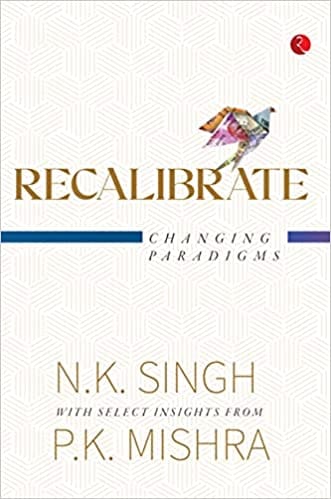
Recalibrate: Changing Paradigms, by N.K. Singh with select insights by P.K. Mishra, attempts to look back in order to look forward—not because the past allows for a linear extension or extrapolation into the future, but because it offers building blocks with which we can be pragmatically creative in navigating the twenty-first century and beyond.
Review
N.K. Singh, with contributions from his distinguished co-author Dr P.K. Mishra, has written a book that outlines the reforms that could transform the Indian economy at this critical time. Recalibrate: Changing Paradigms constitutes the most penetrating commentary on the Indian economy today. —Jagdish N. Bhagwati, University Professor (Economics, Law, and International Relations), Columbia University
N.K. Singh’s new book comes at a time of global uncertainty. The combination of challenges—of recurring pandemics, geopolitical conflict and hurdles to sustainability and economic development—requires fresh domestic and multilateral responses. Together with Dr P.K. Mishra, N.K. Singh shines a light on the new thinking required and possible solutions, drawing on his leadership in policymaking. We ought to heed the book’s call for a recalibration of social contracts and mutual obligations within and among nations. —Tharman Shanmugaratnam, Senior Minister, Singapore and Chairman, Group of Thirty
In Recalibrate: Changing Paradigms, N.K. Singh, wisely and rightly, calls for a sustainable, resilient and innovative approach to growth and development. He is informed and positive about the ways forward to a productive economy and society and he applies his wealth of practical experience to how they can be delivered. In so doing, he also draws on the great experience and thoughtfulness of Dr P.K. Mishra. These ideas are already shaping India’s future. The world should listen. —Lord Nicholas Stern, CH, Kt, FBA, FRS, Chairman, Grantham Research Institute on Climate Change and the Environment, London School of Economics
The more the world changes, the more is the experience needed to chart out a course forward. In this important volume N.K. Singh and P.K. Mishra draw on their vast experience given in helping policy actors think and for thinkers to act for providing guidance on the main issues of the day. India’s issues are the world’s concern and this book deserves a global audience. —Lawrence H. Summers, President Emeritus, Harvard University
About the Author
N.K. Singh is a prominent Indian economist, academician and policymaker. He chaired the Fifteenth Finance Commission and is currently the president of the Institute of Economic Growth (IEG). Prior to this position, he presided as chairman of the Fiscal Responsibility and Budget Management Review Committee (FRBM). He also served as a member of the Rajya Sabha (2008–2014). Earlier, he was secretary to the Prime Minister of India (1998–2001). He is the co-chairman of the India Advisory Board of the London School of Economics (LSE). Singh has been a recurring eminent guest lecturer at prestigious academic institutions and universities like Columbia, Yale, Stanford and the LSE. His autobiography, Portraits of Power: Half a Century of Being at Ringside was published in 2020.
P.K. Mishra, currently the principal secretary to the prime minister of India, has, as a former member of the Indian Administrative Service, varied work experience in field organizations as well as at policymaking levels of government. He has held various key positions with both the central and Gujarat state governments. He also worked as chairman, Gujarat Electricity Regulatory Commission (GERC). Mishra has authored The Kutch Earthquake 2001: Recollections, Lessons and Insights (2005) and Agricultural Risk, Insurance and Income: Study of the Impact and Design of India’s Comprehensive Crop Insurance Scheme (1996). He was conferred the Sasakawa Award 2019 for Disaster Risk Reduction by the United Nations Office for Disaster Risk Reduction (UNDRR).










 +91 9818282497
(2).png)