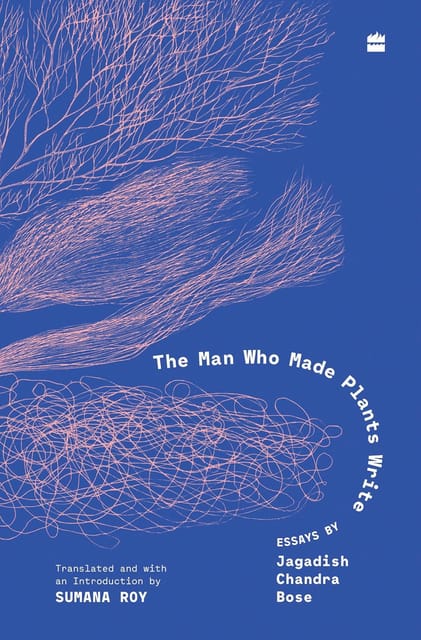
In The Man Who Made Plants Write, internationally renowned poet and critic Sumana Roy translates Jagadish Chandra Bose's revolutionary writings on the environment.
Bose (1858-1937), a scientist and polymath, devoted much of his time to presenting a sophisticated vision of plant communication. He suggested that trees had an 'unvoiced life', their own idiom as it were, a way of responding to each other and to the world around, which could be recorded as a 'script' with a crescograph. In his essay collection Abyakta - 'The Unsaid' - Bose implored his readers to tune into the 'airborne sounds' these beings emitted and to the 'endless music sung everywhere'.
More than a hundred years after Abyakta's publication, Sumana Roy, in a translation that is nuanced, tender and rich in lyricism, brings to readers Bose's legacy - his body of work engaging with the natural world's innate intelligence. His views, dismissed as idiosyncratic and unscientific when he was alive, have only gained in significance over time, as climate experts call for a plant-sentience-led approach to conservation. By provocatively challenging a hierarchy of living beings where flora and fauna get relegated to the bottom, and by reminding us of the need to approach the issue of sustainability through the lens of compassion, Bose's work remains relevant, urgent and, in many ways, prophetic.

Jagadish Chandra Bose (1858 1937) was a pioneer in radio waves, electromagnetism, and plant science. His books published in English include Response in the Living and Non-Living (1902) and The Nervous Mechanism of Plants (1926).
Sumana Roy is the author of How I Became a Tree, Provincials: Postcards from the Peripheries and Plant Thinkers of Twentieth-Century Bengal, among other books.
In The Man Who Made Plants Write, internationally renowned poet and critic Sumana Roy translates Jagadish Chandra Bose's revolutionary writings on the environment.
Bose (1858-1937), a scientist and polymath, devoted much of his time to presenting a sophisticated vision of plant communication. He suggested that trees had an 'unvoiced life', their own idiom as it were, a way of responding to each other and to the world around, which could be recorded as a 'script' with a crescograph. In his essay collection Abyakta - 'The Unsaid' - Bose implored his readers to tune into the 'airborne sounds' these beings emitted and to the 'endless music sung everywhere'.
More than a hundred years after Abyakta's publication, Sumana Roy, in a translation that is nuanced, tender and rich in lyricism, brings to readers Bose's legacy - his body of work engaging with the natural world's innate intelligence. His views, dismissed as idiosyncratic and unscientific when he was alive, have only gained in significance over time, as climate experts call for a plant-sentience-led approach to conservation. By provocatively challenging a hierarchy of living beings where flora and fauna get relegated to the bottom, and by reminding us of the need to approach the issue of sustainability through the lens of compassion, Bose's work remains relevant, urgent and, in many ways, prophetic.
Jagadish Chandra Bose (1858 1937) was a pioneer in radio waves, electromagnetism, and plant science. His books published in English include Response in the Living and Non-Living (1902) and The Nervous Mechanism of Plants (1926).
Sumana Roy is the author of How I Became a Tree, Provincials: Postcards from the Peripheries and Plant Thinkers of Twentieth-Century Bengal, among other books.
Subscribe to get Email Updates!
Thanks for subscribing.
Your response has been recorded.
"We Believe In The Power of Books" Our mission is to make books accessible to everyone, and to cultivate a culture of reading and learning. We strive to provide a wide range of books, from classic literature, sci-fi and fantasy, to graphic novels, biographies and self-help books, so that everyone can find something to read.
Whether you’re looking for your next great read, a gift for someone special, or just browsing, Midland is here to make your book-buying experience easy and enjoyable.
(2).png)