Shop No.20, Aurobindo Palace Market, Hauz Khas, Near Church +91 9818282497 | 011 26867121 110016 New Delhi IN
Midland The Book Shop ™
Shop No.20, Aurobindo Palace Market, Hauz Khas, Near Church +91 9818282497 | 011 26867121 New Delhi, IN
+919871604786 https://www.midlandbookshop.com/s/607fe93d7eafcac1f2c73ea4/69591829db7aed90e0608dfb/without-tag-line-480x480.png" [email protected]
9781910695296 631b2eb4609fa22c7a78271a River https://www.midlandbookshop.com/s/607fe93d7eafcac1f2c73ea4/631b2eb5609fa22c7a782884/217poiixhzl-_sx325_bo1-204-203-200_.jpg
‘After many years I had excised myself from the life I had led in town, just as one might cut a figure out of a landscape or group photo. Abashed by the harm I had wreaked on the picture left behind, and unsure where the cut-out might end up next, I lived a provisional existence. I did so in a place where I knew none of my neighbours, where the street names, views, smells and faces were all unfamiliar to me, in a cheaply appointed flat where I would be able to lay my life aside for a while.’
In River, a woman moves to a London suburb for reasons that are unclear. She takes long, solitary walks by the River Lea, observing and describing her surroundings and the unusual characters she encounters. Over the course of these wanderings she amasses a collection of found objects and photographs and is drawn into reminiscences of the different rivers which haunted the various stages of her life, from the Rhine, where she grew up, to the Saint Lawrence, the Hooghly, and the banks of the Oder. Written in language that is as precise as it is limpid, River is a remarkable novel, full of poignant images and poetic observations, an ode to nature, edgelands, and the transience of all things human.


Review

River is an unusual and stealthy sort of book in that it’s the opposite of what it appears to be – which is a rather apt dissimulation, as it turns out. Yes, it rifles through both the rich and rank materials of the world, turning over its trinkets and its tat, in a manner that is initially quite familiar – however, this curious inventory demonstrates an eye for the grotesque and does not hold the world aloft, or in place. Here, details blur boundaries rather than reaffirming them, positing a worldview that is haunted and uncanny. Shifting through unremarkable terrain we encounter the departed, the exiled, the underneath, the other side. We are on firm ground, always; yet whether that ground is here or there, now or then, is, increasingly, a distinction that is difficult and perhaps irrelevant to make. Sea or sky, boy or girl, east or west, king or vagrant, silt or gold; by turns grubby, theatrical, and exquisite, we are closer to the realm of Bakhtin’s carnival than we are to the well-trod paths of psychogeography. Kinsky’s River does indeed force us to stop in our tracks and take in the opposite side.’
- Claire-Louise Bennett, author of Pond


‘Our narrator is an ambulant consciousness open to stimulus, like a video recorder left running. She's not searching for anything. She's just there, enduring in the company of rust, moss, dirt, cracks, puddles, half-dead grass, rubbish, wire, random bricks, concrete without purpose, the blackened ground from past bonfires, holes, fragments of fabric, plastic toys, weeds, saplings and dead animals. […] [River's] main subject is the sense of materiality, and its complement, light, that accompanies the narrator from her childhood on the Rhine through sojourns in other riparians homes-from-home, on the St Lawrence in Canada, on the Vistula in Poland. […] The form of River mirrors its content; its consciousness flows with a sense that, like water to the sea, it will one day lose itself. It is appropriately, seamlessly translated by Iain Galbraith.’
- Lesley Chamberlain, Times Literary Supplement


‘Rich in atmosphere, River meanders like its liquid locales […] Iain Galbraith, who has also translated Sebald, gives River, and all its "lumber of cumbersome jetsam", a special English poetry of grunge and grime.’
The Economist


‘A magnificent novel.’
The New Yorker

About the Author

Esther Kinsky grew up by the river Rhine and lived in London for twelve years. She is the author of six volumes of poetry, four novels (Summer ResortBanatskoRiverGrove) numerous essays on language, poetry and translation and three children’s books. She has translated many notable English (John Clare, Henry David Thoreau, Iain Sinclair) and Polish (Joanna Bator, Miron Bia?oszewski, Magdalena Tulli) authors into German. Both River and Grove won numerous literary prizes in Germany. 


Iain Galbraith was born and grew up on the west coast of Scotland and now lives in Germany. He is a poet and translator (Natascha Wodin, Alfred Kolleritsch, W. G. Sebald, Jan Wagner) and has received several prizes for his work, including, most recently, the Popescu European Poetry Translation Prize (2015) and the Schlegel-Tieck Prize (2016).

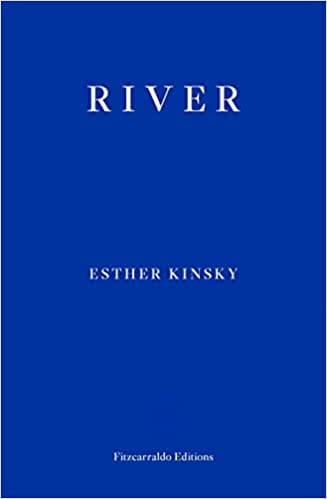
9781910695296
out of stock INR 799
1 1

River

ISBN: 9781910695296
₹799
₹999   (20% OFF)


Back In Stock Shortly - Fill The Book Request Form

Details
  • ISBN: 9781910695296
  • Author: Esther Kinsky
  • Publisher: Fitzcarraldo Editions
  • Pages: 368
  • Format: Paperback
SHARE PRODUCT

Book Description

‘After many years I had excised myself from the life I had led in town, just as one might cut a figure out of a landscape or group photo. Abashed by the harm I had wreaked on the picture left behind, and unsure where the cut-out might end up next, I lived a provisional existence. I did so in a place where I knew none of my neighbours, where the street names, views, smells and faces were all unfamiliar to me, in a cheaply appointed flat where I would be able to lay my life aside for a while.’
In River, a woman moves to a London suburb for reasons that are unclear. She takes long, solitary walks by the River Lea, observing and describing her surroundings and the unusual characters she encounters. Over the course of these wanderings she amasses a collection of found objects and photographs and is drawn into reminiscences of the different rivers which haunted the various stages of her life, from the Rhine, where she grew up, to the Saint Lawrence, the Hooghly, and the banks of the Oder. Written in language that is as precise as it is limpid, River is a remarkable novel, full of poignant images and poetic observations, an ode to nature, edgelands, and the transience of all things human.


Review

River is an unusual and stealthy sort of book in that it’s the opposite of what it appears to be – which is a rather apt dissimulation, as it turns out. Yes, it rifles through both the rich and rank materials of the world, turning over its trinkets and its tat, in a manner that is initially quite familiar – however, this curious inventory demonstrates an eye for the grotesque and does not hold the world aloft, or in place. Here, details blur boundaries rather than reaffirming them, positing a worldview that is haunted and uncanny. Shifting through unremarkable terrain we encounter the departed, the exiled, the underneath, the other side. We are on firm ground, always; yet whether that ground is here or there, now or then, is, increasingly, a distinction that is difficult and perhaps irrelevant to make. Sea or sky, boy or girl, east or west, king or vagrant, silt or gold; by turns grubby, theatrical, and exquisite, we are closer to the realm of Bakhtin’s carnival than we are to the well-trod paths of psychogeography. Kinsky’s River does indeed force us to stop in our tracks and take in the opposite side.’
- Claire-Louise Bennett, author of Pond


‘Our narrator is an ambulant consciousness open to stimulus, like a video recorder left running. She's not searching for anything. She's just there, enduring in the company of rust, moss, dirt, cracks, puddles, half-dead grass, rubbish, wire, random bricks, concrete without purpose, the blackened ground from past bonfires, holes, fragments of fabric, plastic toys, weeds, saplings and dead animals. […] [River's] main subject is the sense of materiality, and its complement, light, that accompanies the narrator from her childhood on the Rhine through sojourns in other riparians homes-from-home, on the St Lawrence in Canada, on the Vistula in Poland. […] The form of River mirrors its content; its consciousness flows with a sense that, like water to the sea, it will one day lose itself. It is appropriately, seamlessly translated by Iain Galbraith.’
- Lesley Chamberlain, Times Literary Supplement


‘Rich in atmosphere, River meanders like its liquid locales […] Iain Galbraith, who has also translated Sebald, gives River, and all its "lumber of cumbersome jetsam", a special English poetry of grunge and grime.’
The Economist


‘A magnificent novel.’
The New Yorker

About the Author

Esther Kinsky grew up by the river Rhine and lived in London for twelve years. She is the author of six volumes of poetry, four novels (Summer ResortBanatskoRiverGrove) numerous essays on language, poetry and translation and three children’s books. She has translated many notable English (John Clare, Henry David Thoreau, Iain Sinclair) and Polish (Joanna Bator, Miron Bia?oszewski, Magdalena Tulli) authors into German. Both River and Grove won numerous literary prizes in Germany. 


Iain Galbraith was born and grew up on the west coast of Scotland and now lives in Germany. He is a poet and translator (Natascha Wodin, Alfred Kolleritsch, W. G. Sebald, Jan Wagner) and has received several prizes for his work, including, most recently, the Popescu European Poetry Translation Prize (2015) and the Schlegel-Tieck Prize (2016).
User reviews

  0/5