Shop No.20, Aurobindo Palace Market, Hauz Khas, Near Church +91 9818282497 | 011 26867121 110016 New Delhi IN
Midland The Book Shop ™
Shop No.20, Aurobindo Palace Market, Hauz Khas, Near Church +91 9818282497 | 011 26867121 New Delhi, IN
+919871604786 https://www.midlandbookshop.com/s/607fe93d7eafcac1f2c73ea4/69591829db7aed90e0608dfb/without-tag-line-480x480.png" [email protected]
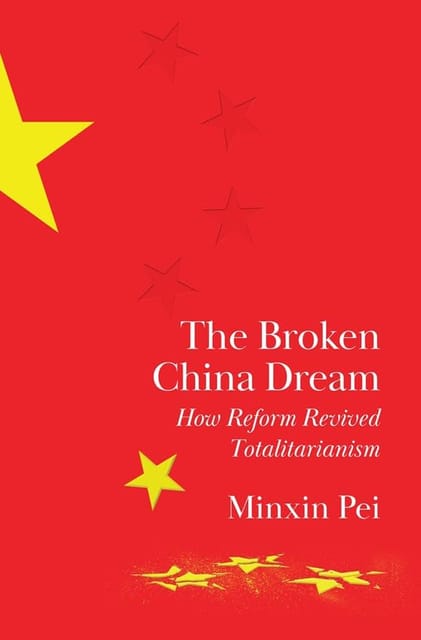
9780691302294 6ac63e83060bd69604481299 The Broken China Dream How Reform Revived Totalitarianism https://www.midlandbookshop.com/s/607fe93d7eafcac1f2c73ea4/6ac63e85060bd696044812a2/41w-dekhszl.jpg
A provocative book that demystifies China s great democratic leap backward under Xi Jinping, revealing why the country s embrace of capitalism has given rise to hard authoritarianism, mass surveillance, and one-man rule instead of democracy as many in the West had hoped

When China embarked on its transformative journey of modernization in 1979, many believed the country s turn toward capitalism would put its totalitarian past to rest and mark the birth of a democratic, open society. Instead, China reverted to a neo-totalitarian state, one backed by one of the fastest-growing, most formidable economies on earth. The Broken China Dream pulls back the curtain on the regime of strongman Xi Jinping, revealing why the reforms of the post-Mao era have been reversed on nearly every front-and why the world failed to see it coming.

Exposing the truth behind China s economic ascendency after the Cultural Revolution, Minxin Pei shows how, following Mao s death in 1976, Deng Xiaoping strategically deployed the tools of capitalism to preserve the Chinese Communist Party. Deng kept intact the institutional foundations of totalitarianism even as he unleashed private entrepreneurship and courted foreign investment, giving China s one-party state control of a vast repressive apparatus and the most critical sectors of the economy. Only a fragile balance of power among dueling factions prevented the rise of a totalitarian leader in the two decades after the Tiananmen crackdown in 1989-but this temporary equilibrium collapsed.

Essential to understanding today s China, this meticulously researched book is a sobering account of why the country s reformers and institutions could not stop a shrewd and ruthless politician like Xi from resurrecting dormant totalitarian practices that, for the foreseeable future, have spelled the end of the dream of a free and prosperous China.

About the Author

Minxin Pei is the author of several acclaimed books on contemporary China, including The Sentinel State: Surveillance and the Survival of Dictatorship in China, China s Crony Capitalism: The Dynamics of Regime Decay, and China s Trapped Transition: The Limits of Developmental Autocracy. He is the Tom and Margot Pritzker 72 Professor of Government and a George R. Roberts Fellow at Claremont McKenna College.

9780691302294
in stock INR 799
1 1

The Broken China Dream How Reform Revived Totalitarianism

ISBN: 9780691302294
₹799
₹999   (20% OFF)


Details
  • ISBN: 9780691302294
  • Author: Minxin Pei
  • Publisher: Princeton University Press
  • Pages: 344
  • Format: Hardback
SHARE PRODUCT

Book Description

A provocative book that demystifies China s great democratic leap backward under Xi Jinping, revealing why the country s embrace of capitalism has given rise to hard authoritarianism, mass surveillance, and one-man rule instead of democracy as many in the West had hoped

When China embarked on its transformative journey of modernization in 1979, many believed the country s turn toward capitalism would put its totalitarian past to rest and mark the birth of a democratic, open society. Instead, China reverted to a neo-totalitarian state, one backed by one of the fastest-growing, most formidable economies on earth. The Broken China Dream pulls back the curtain on the regime of strongman Xi Jinping, revealing why the reforms of the post-Mao era have been reversed on nearly every front-and why the world failed to see it coming.

Exposing the truth behind China s economic ascendency after the Cultural Revolution, Minxin Pei shows how, following Mao s death in 1976, Deng Xiaoping strategically deployed the tools of capitalism to preserve the Chinese Communist Party. Deng kept intact the institutional foundations of totalitarianism even as he unleashed private entrepreneurship and courted foreign investment, giving China s one-party state control of a vast repressive apparatus and the most critical sectors of the economy. Only a fragile balance of power among dueling factions prevented the rise of a totalitarian leader in the two decades after the Tiananmen crackdown in 1989-but this temporary equilibrium collapsed.

Essential to understanding today s China, this meticulously researched book is a sobering account of why the country s reformers and institutions could not stop a shrewd and ruthless politician like Xi from resurrecting dormant totalitarian practices that, for the foreseeable future, have spelled the end of the dream of a free and prosperous China.

About the Author

Minxin Pei is the author of several acclaimed books on contemporary China, including The Sentinel State: Surveillance and the Survival of Dictatorship in China, China s Crony Capitalism: The Dynamics of Regime Decay, and China s Trapped Transition: The Limits of Developmental Autocracy. He is the Tom and Margot Pritzker 72 Professor of Government and a George R. Roberts Fellow at Claremont McKenna College.

User reviews

  0/5