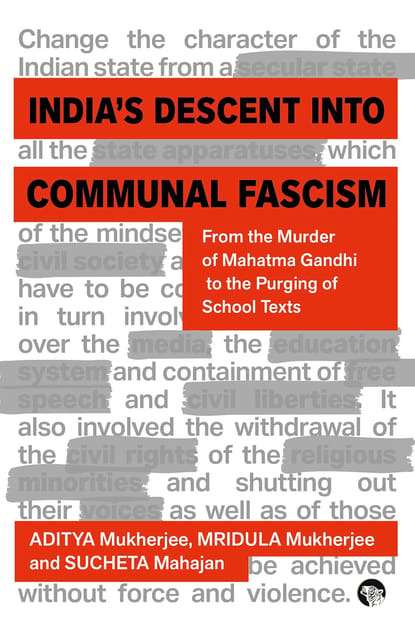
The rewriting of history is not simply about changing a few lines in a textbook. It is about changing the way generations of Indians remember the freedom struggle, understand their fellow citizens and imagine the nation itself. What children learn in school shapes how they understand their country, its history and its people. When that history is distorted, selectively erased or rewritten to create enemies, the consequences can reach far beyond the classroom.
In India s Descent into Communal Fascism, historians Aditya Mukherjee, Mridula Mukherjee and Sucheta Mahajan examine the long campaign to reshape the teaching of Indian history along communal lines. They trace the RSS s continued effort to use education and historical narratives to promote a vision of India in which Hindu majoritarian identity is placed at the centre of the nation, while minorities, particularly Muslims, are cast as outsiders and threats.
At the heart of this narrative lies the murder of Mahatma Gandhi. His assassination in 1948 was not, the authors argue, an isolated act of violence. Instead, it was the most devastating expression of an ideology that rejected Gandhi s vision of a united, secular India the very Idea of India that propelled the national freedom struggle. The book discusses in detail the conspiracy surrounding the Mahatma s murder, the ideological climate that made it possible, and the relentless attempts to obscure or diminish this history.
From the killing of Gandhi to the misrepresentations in school syllabi, and from the RSS s ideological foundations to the politics of the present, this compelling book examines the forces challenging India s secular and democratic inheritance. It is a powerful and timely account of how hatred is cultivated, history is rewritten and a nation s idea of itself is subverted.

Aditya Mukherjee taught history at Jawaharlal Nehru University (JNU) for over four decades. His major publications include Nehru s India: Past, Present and Future, 2024, Political Economy of Colonial and Post-Colonial India, 2022 and Imperialism, Nationalism and the Making of the Indian Capitalist Class, 2002. He has co-authored India Since Independence and India s Struggle for Independence. He was the General President of the Indian History Congress.
Mridula Mukherjee taught history at JNU for over four decades. Her major publications include Peasants in India s Non-violent Revolution, 2004 and Colonialising Agriculture: The Myth of Punjab Exceptionalism
The rewriting of history is not simply about changing a few lines in a textbook. It is about changing the way generations of Indians remember the freedom struggle, understand their fellow citizens and imagine the nation itself. What children learn in school shapes how they understand their country, its history and its people. When that history is distorted, selectively erased or rewritten to create enemies, the consequences can reach far beyond the classroom.
In India s Descent into Communal Fascism, historians Aditya Mukherjee, Mridula Mukherjee and Sucheta Mahajan examine the long campaign to reshape the teaching of Indian history along communal lines. They trace the RSS s continued effort to use education and historical narratives to promote a vision of India in which Hindu majoritarian identity is placed at the centre of the nation, while minorities, particularly Muslims, are cast as outsiders and threats.
At the heart of this narrative lies the murder of Mahatma Gandhi. His assassination in 1948 was not, the authors argue, an isolated act of violence. Instead, it was the most devastating expression of an ideology that rejected Gandhi s vision of a united, secular India the very Idea of India that propelled the national freedom struggle. The book discusses in detail the conspiracy surrounding the Mahatma s murder, the ideological climate that made it possible, and the relentless attempts to obscure or diminish this history.
From the killing of Gandhi to the misrepresentations in school syllabi, and from the RSS s ideological foundations to the politics of the present, this compelling book examines the forces challenging India s secular and democratic inheritance. It is a powerful and timely account of how hatred is cultivated, history is rewritten and a nation s idea of itself is subverted.
Aditya Mukherjee taught history at Jawaharlal Nehru University (JNU) for over four decades. His major publications include Nehru s India: Past, Present and Future, 2024, Political Economy of Colonial and Post-Colonial India, 2022 and Imperialism, Nationalism and the Making of the Indian Capitalist Class, 2002. He has co-authored India Since Independence and India s Struggle for Independence. He was the General President of the Indian History Congress.
Mridula Mukherjee taught history at JNU for over four decades. Her major publications include Peasants in India s Non-violent Revolution, 2004 and Colonialising Agriculture: The Myth of Punjab Exceptionalism
Subscribe to get Email Updates!
Thanks for subscribing.
Your response has been recorded.
"We Believe In The Power of Books" Our mission is to make books accessible to everyone, and to cultivate a culture of reading and learning. We strive to provide a wide range of books, from classic literature, sci-fi and fantasy, to graphic novels, biographies and self-help books, so that everyone can find something to read.
Whether you’re looking for your next great read, a gift for someone special, or just browsing, Midland is here to make your book-buying experience easy and enjoyable.
(2).png)