A landmark study of Gandhi s political thought and action, now in a revised edition, by one of India s finest political theorists.
How can a society reform itself without repudiating its past? How can it learn from other civilisations without accepting their judgement of its inferiority? And how can tradition remain a source of moral authority without becoming an obstacle to change?
These questions lie at the heart of Bhikhu Parekh s landmark study of Gandhi s political discourse. Colonialism, Parekh argues, did more than impose foreign rule on India. It unsettled the country s sense of itself, forced Indians to defend their beliefs and practices in categories defined by their rulers, and profoundly altered the terms on which tradition could be understood, let alone questioned and renewed.
Gandhi s response was neither orthodox nor fully modernist. Seeking a new yugadharma for a new India, he drew upon the resources of Hindu tradition while opening them to moral insights from other religions and intellectual traditions. He was at once a radical reformer and a figure deeply marked by the limits of the society he sought to transform.
With rare intellectual sympathy, Parekh examines Gandhi s reworking of ahimsa; his dialogue with the revolutionaries; his campaign against untouchability; his controversial experiments in celibacy; his distinctively Indian remaking of autobiography; and the tensions within his economic and political worldview. The book culminates in a searching meditation on the crisis of religion in the modern world and the changes it must undergo if it is to retain a place in public life.
Neither hagiography nor refutation, Colonialism, Tradition and Reform remains one of the most incisive studies of Gandhi s originality, achievements, contradictions and failures. At a time when questions of religious identity, social reform, cultural self-confidence and political morality have acquired renewed force, this book remains indispensable for any student of India.

Bhikhu Parekh is Emeritus Professor of Political Theory at the University of Hull. He has been Visiting Professor at several universities, including McGill, Harvard, the Institute of Advanced Study in Vienna, the University of Pennsylvania, and Universitat Pompeu Fabra in Barcelona. He was Vice-Chancellor of the University of Baroda from 1981 to 1984. He is the author of several widely acclaimed books in political philosophy, including Rethinking Multiculturalism, published by Harvard University Press in 2000. He also chaired the Commission on the Future of Multi-Ethnic Britain, whose report, known as the Parekh Report, was published in 2000. Active in British political life, he w
A landmark study of Gandhi s political thought and action, now in a revised edition, by one of India s finest political theorists.
How can a society reform itself without repudiating its past? How can it learn from other civilisations without accepting their judgement of its inferiority? And how can tradition remain a source of moral authority without becoming an obstacle to change?
These questions lie at the heart of Bhikhu Parekh s landmark study of Gandhi s political discourse. Colonialism, Parekh argues, did more than impose foreign rule on India. It unsettled the country s sense of itself, forced Indians to defend their beliefs and practices in categories defined by their rulers, and profoundly altered the terms on which tradition could be understood, let alone questioned and renewed.
Gandhi s response was neither orthodox nor fully modernist. Seeking a new yugadharma for a new India, he drew upon the resources of Hindu tradition while opening them to moral insights from other religions and intellectual traditions. He was at once a radical reformer and a figure deeply marked by the limits of the society he sought to transform.
With rare intellectual sympathy, Parekh examines Gandhi s reworking of ahimsa; his dialogue with the revolutionaries; his campaign against untouchability; his controversial experiments in celibacy; his distinctively Indian remaking of autobiography; and the tensions within his economic and political worldview. The book culminates in a searching meditation on the crisis of religion in the modern world and the changes it must undergo if it is to retain a place in public life.
Neither hagiography nor refutation, Colonialism, Tradition and Reform remains one of the most incisive studies of Gandhi s originality, achievements, contradictions and failures. At a time when questions of religious identity, social reform, cultural self-confidence and political morality have acquired renewed force, this book remains indispensable for any student of India.
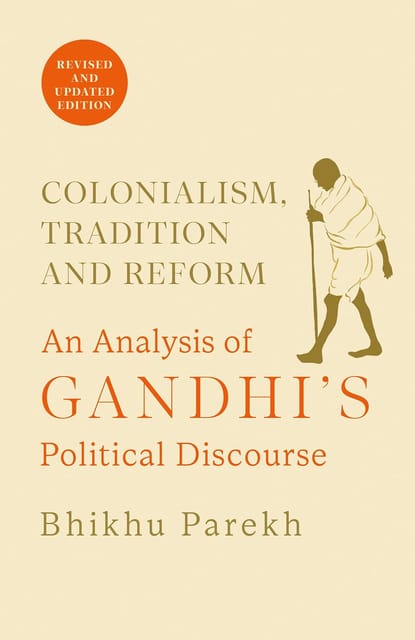
Bhikhu Parekh is Emeritus Professor of Political Theory at the University of Hull. He has been Visiting Professor at several universities, including McGill, Harvard, the Institute of Advanced Study in Vienna, the University of Pennsylvania, and Universitat Pompeu Fabra in Barcelona. He was Vice-Chancellor of the University of Baroda from 1981 to 1984. He is the author of several widely acclaimed books in political philosophy, including Rethinking Multiculturalism, published by Harvard University Press in 2000. He also chaired the Commission on the Future of Multi-Ethnic Britain, whose report, known as the Parekh Report, was published in 2000. Active in British political life, he w
Subscribe to get Email Updates!
Thanks for subscribing.
Your response has been recorded.
"We Believe In The Power of Books" Our mission is to make books accessible to everyone, and to cultivate a culture of reading and learning. We strive to provide a wide range of books, from classic literature, sci-fi and fantasy, to graphic novels, biographies and self-help books, so that everyone can find something to read.
Whether you’re looking for your next great read, a gift for someone special, or just browsing, Midland is here to make your book-buying experience easy and enjoyable.
(2).png)