Shop No.20, Aurobindo Palace Market, Hauz Khas, Near Church +91 9818282497 | 011 26867121 110016 New Delhi IN
Midland The Book Shop ™
Shop No.20, Aurobindo Palace Market, Hauz Khas, Near Church +91 9818282497 | 011 26867121 New Delhi, IN
+919871604786 https://www.midlandbookshop.com/s/607fe93d7eafcac1f2c73ea4/69591829db7aed90e0608dfb/without-tag-line-480x480.png" [email protected]
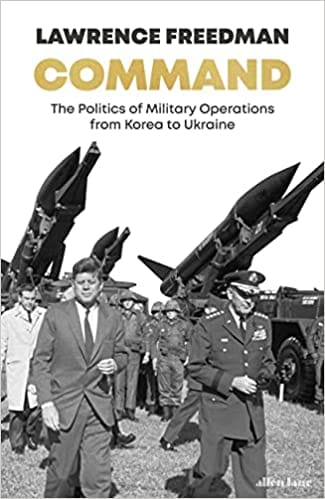
9780241456996 638899e54f5558b77df85b3d Command The Politics Of Military Operations From Korea To Ukraine https://www.midlandbookshop.com/s/607fe93d7eafcac1f2c73ea4/638899e64f5558b77df85b6e/41lgqe1hixl-_sx323_bo1-204-203-200_.jpg

Throughout history, the concept of command -- as both a way to achieve objectives and as an assertion of authority -- has been essential to military action and leadership. But, as Sir Lawrence Freedman shows, it is also deeply political.

Military command has been reconstructed and revolutionized since the Second World War by nuclear warfare, small-scale guerrilla land operations and cyber interference. Freedman takes a global perspective, systematically investigating its practice and politics since 1945 through a wide range of conflicts from the French Colonial Wars, the Cuban Missile Crisis and the Bangladesh Liberation War to North Vietnam's Easter Offensive of 1972, the Falklands War, the Iraq War and Russia's wars in Chechnya and Ukraine. By highlighting the political nature of strategy, Freedman shows that military decision-making cannot be separated from civilian priorities and that commanders must now have the sensibility to navigate politics as well as warfare.


Review

Lawrence Freedman is the dominant academic authority in Britain and the English-speaking world on the way modern wars have been fought. Rational, liberal-minded, clear-sighted, he has drawn on a lifetime of experience for his new book. ... Command is the history of our time, told through war. It's a wonderful, idiosyncratic feat of storytelling as well as an essential account of how the modern world's wars have been fought, written by someone whose grasp of complex detail is as strong and effective as the clarity of his style. I shall read it again and again. -- John Simpson - The Guardian

superb study of high command and civil-military relations ... It is simply one of the finest books I have read in ages, and full of lessons for contemporary leaders. Highly recommended! -- Mick Ryan

wise ... insightful ... masterly ... One suspects that this well-researched, well-written and thought-provoking book will soon be required reading for any Nato officer hoping to exercise high command -- Andrew Roberts - BBC History Magazine

Freedman offers excellent concise summaries of some of the world's main clashes since 1950 ... The author makes an encouraging point when he concludes this useful book: "The advantages of democratic systems lie not in their ability to avoid bad decisions, either by governments or commanders . . . The advantage lies in their ability to recognise these mistakes, learn and adapt. Closed systems, in which subordinates dare not ask awkward questions . . . will suffer operationally." -- Max Hastings - Sunday Times

Lawrence Freedman is one of our most distinguished military historians. In this thoughtful book, drawing on decades of study, he looks at the marriage of authorities that takes place in the running of wars since 1945: where political power meets military expertise, and who ends up having the final say. ... sumptuous ... this should be the standard text in staff colleges around the world, and for military-history studies. -- Simon Heffer - Daily Telegraph

It is incredibly insightful, occasionally moving and profoundly wise. -- Andrew Roberts - Times Literary Supplement Books of the Year

In this broad survey of command in war since 1945, Lawrence Freedman brings to bear his extensive knowledge to explain the many complexities commanders at the highest level must now face, from grasping new ways of warfare to managing military organisation and supply and, above all, coping with the mercurial behaviour of their political masters. If there is a theme to Freedman's book, which ranges from the Korean War to Putin's 'special military operation' in Ukraine, it is to be found in the tensions and conflicts between military leaders and the politicians who call the shots that he documents. How often must a supreme commander have wished he were free to do what he wanted? Usually, politics has to be factored in. ... One of the revelations of Freedman's detailed and well-informed book is how difficult the management of conflict has become ... [an] invaluable panorama of the challenges of modern command -- Richard Overy - Literary Review

Command is arguably his finest book - fluently written and convincingly argued - into which he distils a lifetime of study into the nature and practice of war. -- Saul David - The Times

Sir Lawrence Freedman, Britain's most distinguished scholar of war, surveys 15 different battles and campaigns ... The lesson is that good command looks both ways, sensitive to the politics raging above while remaining in touch with the war being fought below. - Economist

comfortably the book of the year. It is a reminder of the human factor as a central component of the so-called correlations of forces in war. -- John Bew - New Statesman Books of the Year

Freedman's mastery of the subject of civil and military leadership in time of war is peerless ... a fascinating study of the psychological and political characteristics that determine success or failure in leadership in war. -- Tom Clonan - The Irish Times

The most brilliant critique of the Ukraine war has just appeared in Command by veteran strategist Professor Sir Lawrence Freedman. The book is about the tangles of command, politicians playing soldiers and soldiers playing politician in nine wars of this century. -- Robert Fox - Evening Standard

Freedman's brilliant insights help us understand the dynamics of a modern military catastrophe. This is a "how to" book for politicians and generals alike. The Kremlin library deserves an urgent copy. -- Financial Times - George Robertson

admirable ... what really makes this study special is that he reminds us that command is about people, both politicians and military men, with all their fears and flaws, vanities and preconceptions. -- Barney White-Spunner - Aspects of History

About the Author

Sir Lawrence Freedman is Emeritus Professor of War Studies at King's College London. He was the official historian of the Falklands Campaign, and a member of the official inquiry into Britain and the 2003 Iraq War ('the Chilcot Inquiry'). He has written extensively on nuclear strategy and the Cold War, and comments regularly on contemporary security issues. He is the author of The Future of WarStrategy, (a Financial Times and Economist book of the year) and A Choice of Enemies: America Confronts the Middle East, which won the 2009 Lionel Gelber Prize and Duke of Westminster's Medal for Military Literature.

9780241456996
out of stock INR 1599
1 1
Command The Politics Of Military Operations From Korea To Ukraine

Command The Politics Of Military Operations From Korea To Ukraine

ISBN: 9780241456996
₹1,599
₹1,999   (20% OFF)


Back In Stock Shortly - Fill The Book Request Form

Details
  • ISBN: 9780241456996
  • Author: Lawrence Freedman
  • Publisher: Allen Lane
  • Pages: 608
  • Format: Hardback
SHARE PRODUCT

Book Description

Throughout history, the concept of command -- as both a way to achieve objectives and as an assertion of authority -- has been essential to military action and leadership. But, as Sir Lawrence Freedman shows, it is also deeply political.

Military command has been reconstructed and revolutionized since the Second World War by nuclear warfare, small-scale guerrilla land operations and cyber interference. Freedman takes a global perspective, systematically investigating its practice and politics since 1945 through a wide range of conflicts from the French Colonial Wars, the Cuban Missile Crisis and the Bangladesh Liberation War to North Vietnam's Easter Offensive of 1972, the Falklands War, the Iraq War and Russia's wars in Chechnya and Ukraine. By highlighting the political nature of strategy, Freedman shows that military decision-making cannot be separated from civilian priorities and that commanders must now have the sensibility to navigate politics as well as warfare.


Review

Lawrence Freedman is the dominant academic authority in Britain and the English-speaking world on the way modern wars have been fought. Rational, liberal-minded, clear-sighted, he has drawn on a lifetime of experience for his new book. ... Command is the history of our time, told through war. It's a wonderful, idiosyncratic feat of storytelling as well as an essential account of how the modern world's wars have been fought, written by someone whose grasp of complex detail is as strong and effective as the clarity of his style. I shall read it again and again. -- John Simpson - The Guardian

superb study of high command and civil-military relations ... It is simply one of the finest books I have read in ages, and full of lessons for contemporary leaders. Highly recommended! -- Mick Ryan

wise ... insightful ... masterly ... One suspects that this well-researched, well-written and thought-provoking book will soon be required reading for any Nato officer hoping to exercise high command -- Andrew Roberts - BBC History Magazine

Freedman offers excellent concise summaries of some of the world's main clashes since 1950 ... The author makes an encouraging point when he concludes this useful book: "The advantages of democratic systems lie not in their ability to avoid bad decisions, either by governments or commanders . . . The advantage lies in their ability to recognise these mistakes, learn and adapt. Closed systems, in which subordinates dare not ask awkward questions . . . will suffer operationally." -- Max Hastings - Sunday Times

Lawrence Freedman is one of our most distinguished military historians. In this thoughtful book, drawing on decades of study, he looks at the marriage of authorities that takes place in the running of wars since 1945: where political power meets military expertise, and who ends up having the final say. ... sumptuous ... this should be the standard text in staff colleges around the world, and for military-history studies. -- Simon Heffer - Daily Telegraph

It is incredibly insightful, occasionally moving and profoundly wise. -- Andrew Roberts - Times Literary Supplement Books of the Year

In this broad survey of command in war since 1945, Lawrence Freedman brings to bear his extensive knowledge to explain the many complexities commanders at the highest level must now face, from grasping new ways of warfare to managing military organisation and supply and, above all, coping with the mercurial behaviour of their political masters. If there is a theme to Freedman's book, which ranges from the Korean War to Putin's 'special military operation' in Ukraine, it is to be found in the tensions and conflicts between military leaders and the politicians who call the shots that he documents. How often must a supreme commander have wished he were free to do what he wanted? Usually, politics has to be factored in. ... One of the revelations of Freedman's detailed and well-informed book is how difficult the management of conflict has become ... [an] invaluable panorama of the challenges of modern command -- Richard Overy - Literary Review

Command is arguably his finest book - fluently written and convincingly argued - into which he distils a lifetime of study into the nature and practice of war. -- Saul David - The Times

Sir Lawrence Freedman, Britain's most distinguished scholar of war, surveys 15 different battles and campaigns ... The lesson is that good command looks both ways, sensitive to the politics raging above while remaining in touch with the war being fought below. - Economist

comfortably the book of the year. It is a reminder of the human factor as a central component of the so-called correlations of forces in war. -- John Bew - New Statesman Books of the Year

Freedman's mastery of the subject of civil and military leadership in time of war is peerless ... a fascinating study of the psychological and political characteristics that determine success or failure in leadership in war. -- Tom Clonan - The Irish Times

The most brilliant critique of the Ukraine war has just appeared in Command by veteran strategist Professor Sir Lawrence Freedman. The book is about the tangles of command, politicians playing soldiers and soldiers playing politician in nine wars of this century. -- Robert Fox - Evening Standard

Freedman's brilliant insights help us understand the dynamics of a modern military catastrophe. This is a "how to" book for politicians and generals alike. The Kremlin library deserves an urgent copy. -- Financial Times - George Robertson

admirable ... what really makes this study special is that he reminds us that command is about people, both politicians and military men, with all their fears and flaws, vanities and preconceptions. -- Barney White-Spunner - Aspects of History

About the Author

Sir Lawrence Freedman is Emeritus Professor of War Studies at King's College London. He was the official historian of the Falklands Campaign, and a member of the official inquiry into Britain and the 2003 Iraq War ('the Chilcot Inquiry'). He has written extensively on nuclear strategy and the Cold War, and comments regularly on contemporary security issues. He is the author of The Future of WarStrategy, (a Financial Times and Economist book of the year) and A Choice of Enemies: America Confronts the Middle East, which won the 2009 Lionel Gelber Prize and Duke of Westminster's Medal for Military Literature.

User reviews

  0/5