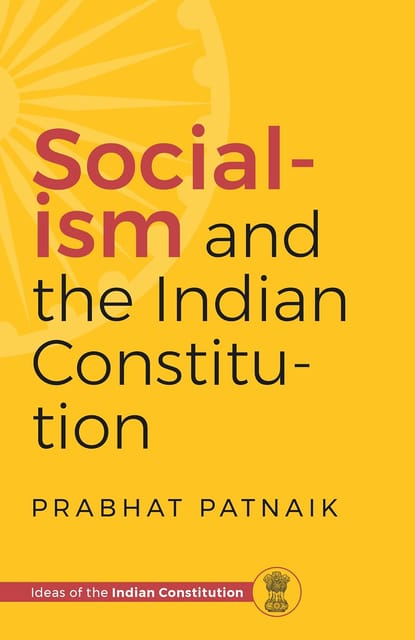
The next book in the acclaimed, accessible series on the Indian Constitution s central ideas, this is a concise, forceful argument tracing how the Constitution s socialist commitments collided with majoritarian politics, and what a credible path towards socialism could look like today.
What does socialist in the Indian Constitution really mean, and how far has policy moved the country towards or away from that promise? In this crisp volume, economist Prabhat Patnaik revisits the anti-colonial imagination of a democratic, secular, egalitarian order; examines the post-Independence dirigiste settlement (planning, public sector, bank nationalization); tracks the neoliberal turn and its consequences for employment, welfare, and popular sovereignty; and maps the political economy of our present. Arguing that equality of opportunity is impossible under persistent unemployment, inherited wealth, and privatized social goods, Patnaik sketches concrete prerequisites universal high-quality public education and healthcare, curbs on inheritance, and a state oriented to social ownership to move towards socialism .
Prabhat Patnaik has taught economics at the University of Cambridge, and at Jawaharlal Nehru University, where he retired from the Sukhamoy Chakravarty Chair and is currently Professor Emeritus. His interests lie in Macroeconomics, Development Economics and Political Economy. His books include Accumulation and Stability Under Capitalism (1997), Re-envisioning Socialism (2007), The Value of Money (2009), A Theory of Imperialism (co-authored with Utsa Patnaik, 2016), Capital and Imperialism (co-authored with Utsa Patnaik, 2021), and Beyond Liberalism (2024). He was the Vice-Chairman of the Kerala State Planning Board between 2006 and 2011.

The next book in the acclaimed, accessible series on the Indian Constitution s central ideas, this is a concise, forceful argument tracing how the Constitution s socialist commitments collided with majoritarian politics, and what a credible path towards socialism could look like today.
What does socialist in the Indian Constitution really mean, and how far has policy moved the country towards or away from that promise? In this crisp volume, economist Prabhat Patnaik revisits the anti-colonial imagination of a democratic, secular, egalitarian order; examines the post-Independence dirigiste settlement (planning, public sector, bank nationalization); tracks the neoliberal turn and its consequences for employment, welfare, and popular sovereignty; and maps the political economy of our present. Arguing that equality of opportunity is impossible under persistent unemployment, inherited wealth, and privatized social goods, Patnaik sketches concrete prerequisites universal high-quality public education and healthcare, curbs on inheritance, and a state oriented to social ownership to move towards socialism .
Prabhat Patnaik has taught economics at the University of Cambridge, and at Jawaharlal Nehru University, where he retired from the Sukhamoy Chakravarty Chair and is currently Professor Emeritus. His interests lie in Macroeconomics, Development Economics and Political Economy. His books include Accumulation and Stability Under Capitalism (1997), Re-envisioning Socialism (2007), The Value of Money (2009), A Theory of Imperialism (co-authored with Utsa Patnaik, 2016), Capital and Imperialism (co-authored with Utsa Patnaik, 2021), and Beyond Liberalism (2024). He was the Vice-Chairman of the Kerala State Planning Board between 2006 and 2011.
Subscribe to get Email Updates!
Thanks for subscribing.
Your response has been recorded.
"We Believe In The Power of Books" Our mission is to make books accessible to everyone, and to cultivate a culture of reading and learning. We strive to provide a wide range of books, from classic literature, sci-fi and fantasy, to graphic novels, biographies and self-help books, so that everyone can find something to read.
Whether you’re looking for your next great read, a gift for someone special, or just browsing, Midland is here to make your book-buying experience easy and enjoyable.
(2).png)