A fire broke out at around 7 pm on 18 July 2012 at Maruti Suzuki India’s manufacturing plant in Manesar. It claimed the life of a manager. Within days, over two thousand temporary workers and 546 permanent workers were dismissed by the company, and 13 of them—including the entire leadership of the workers’ union—were later charged for murder, thus ending yet another independent body for collective bargaining.
Unions are the last, and often only, line of defence workers have in modern industries, especially when the management isn’t averse to undermining their rights, dignity and health in pursuit of higher profits. This was true of Maruti Suzuki. Workers would get a seven-and-a-half-minute break from physically demanding work—precise to the hundredth of a second—to run to the toilet half a kilometre away and force a samosa and piping hot tea down their throat. But they were denied two minutes of silence in the memory of a deceased colleague’s mother.
The sabotage of their efforts at effective unionizing, generally in collusion with the Haryana state government, had therefore come as no surprise to the workers. Yet they struggled through and managed to form successive representative bodies at both the Gurgaon plant, and the one set up in Manesar in 2007. But not only were all of them crushed, some were never allowed to be officially registered.
The often misrepresented events of July 2012 were thus far from an isolated incident. But few today, as then, are willing to see the matter from the workers’ point of view.
Anjali Deshpande and Nandita Haksar tell the story of the biggest car manufacturer in India through the voices of the workers, interviewed over a period of 3 years. As they tell us of their resistance to being turned into robots by an uncompromising management, it becomes abundantly clear that the Maruti Suzuki revolution wasn’t the unmitigated success it was touted to be.

Anjali Deshpande is a journalist and activist. She has participated in many campaigns and movements including the women’s movement and the Bhopal gas tragedy survivors’ struggle for justice. She is also a novelist and writes mainly in Hindi.
Nandita Haksar is a human rights lawyer, teacher and campaigner. She has represented contract workers and trade unions in the Supreme Court. She writes extensively and has published several books, including on the trade union movement in Kashmir and migrant workers from the Northeast. She is the author of The Many Faces of Kashmiri Nationalism and The Exodus Is Not Over.
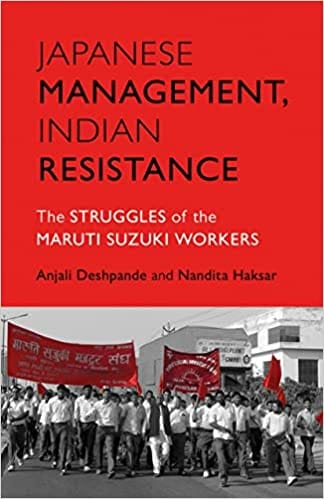
A fire broke out at around 7 pm on 18 July 2012 at Maruti Suzuki India’s manufacturing plant in Manesar. It claimed the life of a manager. Within days, over two thousand temporary workers and 546 permanent workers were dismissed by the company, and 13 of them—including the entire leadership of the workers’ union—were later charged for murder, thus ending yet another independent body for collective bargaining.
Unions are the last, and often only, line of defence workers have in modern industries, especially when the management isn’t averse to undermining their rights, dignity and health in pursuit of higher profits. This was true of Maruti Suzuki. Workers would get a seven-and-a-half-minute break from physically demanding work—precise to the hundredth of a second—to run to the toilet half a kilometre away and force a samosa and piping hot tea down their throat. But they were denied two minutes of silence in the memory of a deceased colleague’s mother.
The sabotage of their efforts at effective unionizing, generally in collusion with the Haryana state government, had therefore come as no surprise to the workers. Yet they struggled through and managed to form successive representative bodies at both the Gurgaon plant, and the one set up in Manesar in 2007. But not only were all of them crushed, some were never allowed to be officially registered.
The often misrepresented events of July 2012 were thus far from an isolated incident. But few today, as then, are willing to see the matter from the workers’ point of view.
Anjali Deshpande and Nandita Haksar tell the story of the biggest car manufacturer in India through the voices of the workers, interviewed over a period of 3 years. As they tell us of their resistance to being turned into robots by an uncompromising management, it becomes abundantly clear that the Maruti Suzuki revolution wasn’t the unmitigated success it was touted to be.
Anjali Deshpande is a journalist and activist. She has participated in many campaigns and movements including the women’s movement and the Bhopal gas tragedy survivors’ struggle for justice. She is also a novelist and writes mainly in Hindi.
Nandita Haksar is a human rights lawyer, teacher and campaigner. She has represented contract workers and trade unions in the Supreme Court. She writes extensively and has published several books, including on the trade union movement in Kashmir and migrant workers from the Northeast. She is the author of The Many Faces of Kashmiri Nationalism and The Exodus Is Not Over.
Subscribe to get Email Updates!
Thanks for subscribing.
Your response has been recorded.

"We Believe In The Power of Books" Our mission is to make books accessible to everyone, and to cultivate a culture of reading and learning. We strive to provide a wide range of books, from classic literature, sci-fi and fantasy, to graphic novels, biographies and self-help books, so that everyone can find something to read.
Whether you’re looking for your next great read, a gift for someone special, or just browsing, Midland is here to make your book-buying experience easy and enjoyable.