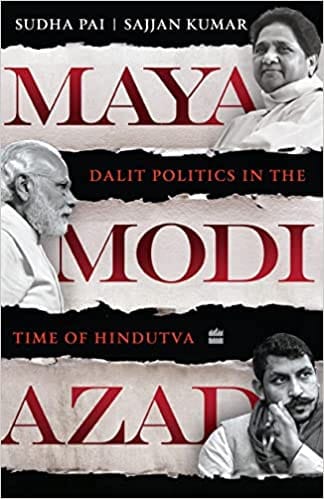
The Dalit political landscape in India offers a difficult analytical puzzle. The last decade has witnessed the decline of the Bahujan Samaj Party and identity politics, along with the shift of a section of Dalits towards the Bharatiya Janata Party and its redefined disadvantaged Hindutva, as well as protests by new Dalit organizations against atrocities and right-wing hegemony. Dalit politics today is thus marked by two contrasting trends: of political protest against but also electoral preference for the right wing.
The story of how the Dalit discourse has responded to the changing socio-political context unfolds against this backdrop. Maya, Modi, Azad maps these shifts with a particular focus on Uttar Pradesh. It is the state where Mayawati, who sought to create a new 'umbrella party' with a Dalit core, and later, Narendra Modi, who attracted a section of Dalits into the saffron fold, have shaped Dalit politics over the last two decades. It is also where a new Dalit leader, Chandrashekhar Azad, is challenging both Hindutva hegemony and the BSP, and is attempting to revive the Dalit movement.
Sudha Pai and Sajjan Kumar's astute and insightful analysis of this triangular contestation is significant for understanding not just Dalit but democratic politics in India as we head into what is likely to be a deeply divisive general election in 2024.
About the Author
Sudha Pai became interested in Dalit politics in the mid-1990s with the emergence of Mayawati on the political landscape, reflected in her book Dalit Assertion and the Unfinished Democratic Revolution: The BSP in Uttar Pradesh (Sage, India, 2002). She is the author of several books, including Developmental State and the Dalit Question in Madhya Pradesh (Routledge India, 2011) and Everyday Communalism (Oxford University Press, 2018).
Sajjan Kumar is a researcher and a political scientist. Currently, he is a Fellow at Nehru Memorial Museum and Library, New Delhi. His writing has been published in The Hindu, Indian Express, The New Indian Express and The Times of India, among others. He is associated with PRACCIS, a Delhi research Institution specializing in fieldwork based political research.




 +91 9818282497
(2).png)