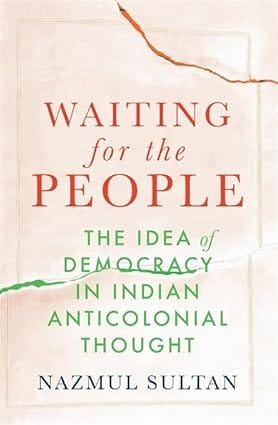
“An engaging, innovative, and wide-ranging account of the way in which anticolonial thought in India creatively reconceptualized the idea of popular sovereignty. It sheds new light on the theoretical relationship between democratic legitimation and development.” —Pratap Bhanu Mehta
An original reconstruction of how the debates over peoplehood defined Indian anticolonial thought, and a bold new framework for theorizing the global career of democracy.
Indians, their former British rulers asserted, were unfit to rule themselves. Behind this assertion lay a foundational claim about the absence of peoplehood in India.The purported “backwardness” of Indians as a people led to a democratic legitimation of empire, justifying self-government at home and imperial rule in the colonies.
In response, Indian anticolonial thinkers launched a searching critique of the modern ideal of peoplehood. Waiting for the People is the first account of Indian answers to the question of peoplehood in political theory. From Surendranath Banerjea and Radhakamal Mukerjee to Mohandas Gandhi and Jawaharlal Nehru, Indian political thinkers passionately explored the fraught theoretical space between sovereignty and government. In different ways, Indian anticolonial thinkers worked to address the developmental assumptions built into the modern problem of peoplehood, scrutinizing contemporary European definitions of “the people” and the assumption that a unified peoplehood was a prerequisite for self-government. Nazmul Sultan demonstrates how the anticolonial reckoning with the ideal of popular sovereignty fostered novel insights into the globalization of democracy and ultimately drove India’s twentieth-century political transformation.
Waiting for the People excavates, at once, the alternative forms and trajectories proposed for India’s path to popular sovereignty and the intellectual choices that laid the foundation for postcolonial democracy. In so doing, it uncovers largely unheralded Indian contributions to democratic theory at large. India’s effort to reconfigure the relationship between popular sovereignty and self-government proves a key event in the global history of political thought, one from which a great deal remains to be learned.

“An engaging, innovative, and wide-ranging account of the way in which anticolonial thought in India creatively reconceptualized the idea of popular sovereignty. It sheds new light on the theoretical relationship between democratic legitimation and development.” —Pratap Bhanu Mehta
An original reconstruction of how the debates over peoplehood defined Indian anticolonial thought, and a bold new framework for theorizing the global career of democracy.
Indians, their former British rulers asserted, were unfit to rule themselves. Behind this assertion lay a foundational claim about the absence of peoplehood in India.The purported “backwardness” of Indians as a people led to a democratic legitimation of empire, justifying self-government at home and imperial rule in the colonies.
In response, Indian anticolonial thinkers launched a searching critique of the modern ideal of peoplehood. Waiting for the People is the first account of Indian answers to the question of peoplehood in political theory. From Surendranath Banerjea and Radhakamal Mukerjee to Mohandas Gandhi and Jawaharlal Nehru, Indian political thinkers passionately explored the fraught theoretical space between sovereignty and government. In different ways, Indian anticolonial thinkers worked to address the developmental assumptions built into the modern problem of peoplehood, scrutinizing contemporary European definitions of “the people” and the assumption that a unified peoplehood was a prerequisite for self-government. Nazmul Sultan demonstrates how the anticolonial reckoning with the ideal of popular sovereignty fostered novel insights into the globalization of democracy and ultimately drove India’s twentieth-century political transformation.
Waiting for the People excavates, at once, the alternative forms and trajectories proposed for India’s path to popular sovereignty and the intellectual choices that laid the foundation for postcolonial democracy. In so doing, it uncovers largely unheralded Indian contributions to democratic theory at large. India’s effort to reconfigure the relationship between popular sovereignty and self-government proves a key event in the global history of political thought, one from which a great deal remains to be learned.
Subscribe to get Email Updates!
Thanks for subscribing.
Your response has been recorded.

"We Believe In The Power of Books" Our mission is to make books accessible to everyone, and to cultivate a culture of reading and learning. We strive to provide a wide range of books, from classic literature, sci-fi and fantasy, to graphic novels, biographies and self-help books, so that everyone can find something to read.
Whether you’re looking for your next great read, a gift for someone special, or just browsing, Midland is here to make your book-buying experience easy and enjoyable.