
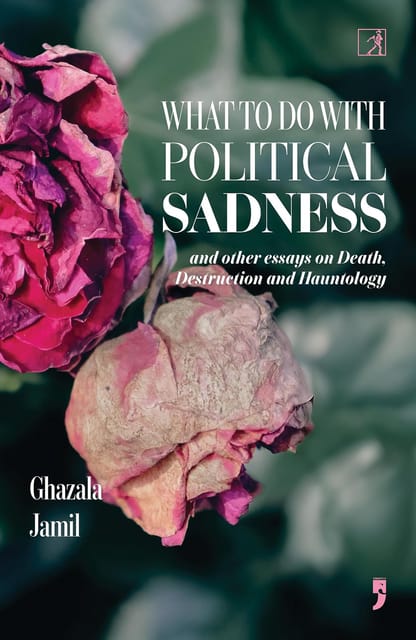
What To Do With Political Sadness And Other Essays On Death, Destruction And Hauntology
ISBN:
9789390343645
₹399
₹499
(20% OFF)
Details
- ISBN: 9789390343645
- Author: Ghazala Jamil
- Publisher: Simon And Schuster
- Pages: 232
- Format: Paperback
Book Description
Have you wondered what happened to the equal and just futures we were told we could look forward to, if only we followed the rules and were reasonable ?
Written as a testimony to spectacular and insidious forms of state violence and supremacist ideologies, What to do with Political Sadness evidences destruction and death as the principal instruments which define the horizon of power.
Combining political philosophy and social critique, Ghazala Jamil seeks to recount and contribute to ideas that compensate for our dimmed capacity to locate ourselves in globally intertwined histories and layered geographies. A collection of engaging essays on themes such as death, violence, and the evisceration of futures, this is Jamil s refusal to accept that sadness induced by juridical, economic and political devastation is pathological.
About the Author
Ghazala Jamil began her career working as a researcher, trainer, and translator supporting grassroots and advocacy groups across India. She has Masters and Doctorate degrees in Social Work from Jamia Millia Islamia and University of Delhi, respectively. She has taught at the Department of Social Work, University of Delhi, and at the School of Planning and Architecture, New Delhi.
She is the author of Accumulation by Segregation: Muslim Localities in Delhi and Muslim Women Speak, and has edited Women in Social Change: Visions, Struggles and Persisting Concerns. She has co-translated Intizar Hussain s Dilli tha Jiska Naam from Urdu to Eng-lish under the title Once There Was a City Named Dilli.
Her writings have also appeared in academic journals and media pub-lications like Antipode, Economic and Political Weekly, Outlook, Frontline, The Telegraph, Hindustan Times, The Indian Express, The Wire, and Scroll.in.










 +91 9818282497
(2).png)